Why two loads with the same miles can pay differently
A carrier-oriented look at load details that change value even when mileage looks similar, with attention to empty miles, appointment pressure, cost exposure, and the next move after delivery.
Written and reviewed by LaneMath Editorial Team, with carrier workflow review from Dale Morrow where practical dispatch, paperwork, or lane-planning context is involved. Updated 2026-06-29. LaneMath pages use public references, example-only math, and conservative editorial review.
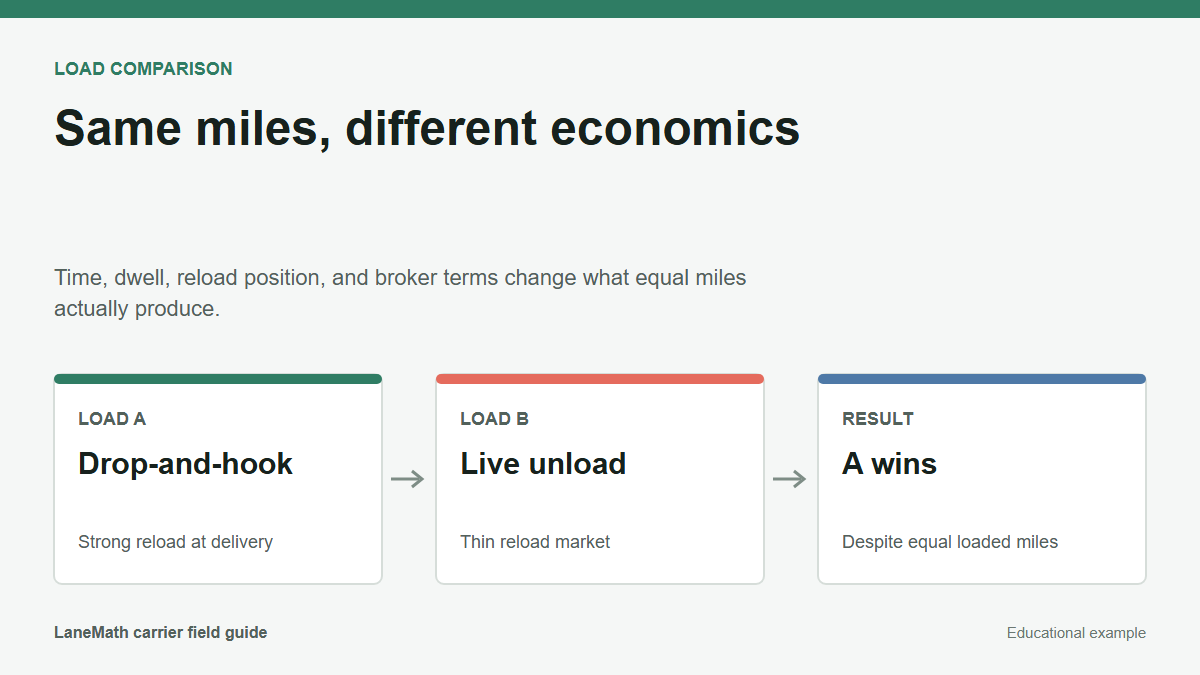
Same-mileage comparison table
Equal loaded miles can hide meaningful differences in time consumed, work required, reload position, and payment risk.
| Signal | Why it matters | Next check |
|---|---|---|
| One load is live, one is drop-and-hook | Live unloading typically adds facility dwell not shown in mileage. | Estimate dwell time and compare net time per dollar. |
| Delivery markets differ | One receiver may be near active freight; the other may require repositioning. | Add post-delivery empty miles to the comparison before deciding. |
| Accessorial language differs | One confirmation may have stronger lumper or detention terms. | Compare both confirmation documents, not just the gross figure. |
| Broker payment terms differ | Cash flow timing can matter as much as the gross amount for some carriers. | Factor in payment timeline when comparing close loads. |
Key takeaways
- Compare appointment times, facility history, weight, equipment, and reload options.
- Look for unpaid labor or waiting risk.
- Review accessorial approval language before dispatch.
Working frame for why two loads with the same miles can pay differently
A carrier-oriented look at load details that change value even when mileage looks similar, with attention to empty miles, appointment pressure, cost exposure, and the next move after delivery. The first operating question is whether the subject changes money, time, equipment fit, payment exposure, or the truck's position after delivery. Keep those effects separate so one attractive number does not hide an unresolved condition.
Checks before the truck is committed
Compare appointment times, facility history, weight, equipment, and reload options. Look for unpaid labor or waiting risk. Review accessorial approval language before dispatch. Write down any term that still depends on a broker reply before dispatch. Confirm the exact commodity, weight, equipment, appointments, facility rules, and approval path that apply to this load rather than relying on a familiar lane or broker relationship.
Equal miles, unequal work
Two loads can show the same loaded miles and still ask for very different service. One may be light, clean, drop-and-hook, and deliver near freight. The other may be heavy, live unload, late appointment, lumper-heavy, and leave the truck in a poor reload position. The mileage is the same only on the map.
What work is hidden behind the mileage?
Compare commodity, weight, appointment type, loading method, receiver requirements, tracking, stops, and reload position. Ask whether either facility has a narrow check-in rule or routine lumper process. Equal map distance says nothing about how much of the driver's day is controlled by the facilities.
Mileage is not a service description
A light drop-and-hook and a heavy live-load grocery delivery can cover the same miles and consume different amounts of fuel and time. Treating the higher-paying load as overpriced or the lower-paying load as acceptable without reviewing service details misses the reason the offers differ.
Compare differences in one view
Put the two offers side by side with total miles, appointments, weight, handling, accessorial rules, broker terms, direct costs, and next-load position. Save the confirmations if either load is booked. A consistent comparison sheet prevents the gross number from becoming the only remembered fact.
Example scenario
Two 510-mile loads pay $1,750 and $1,980. The higher offer requires a 42,000-pound live load, a 4 a.m. grocery appointment, and lumper handling. The lower offer is a daytime drop-and-hook near the next pickup. The $230 difference has to be judged against the added work and risk. The numbers and circumstances are educational examples; replace them with the actual route, written terms, costs, and operating limits for the load being considered.
What to check before booking
- Compare appointment times, facility history, weight, equipment, and reload options.
- Look for unpaid labor or waiting risk.
- Review accessorial approval language before dispatch.
- Write down any term that still depends on a broker reply before dispatch.
Common questions
If two loads have the same loaded miles, why might one be clearly better?
Appointment timing, facility type, driver-assist requirements, reload position, broker payment terms, and accessorial language can all make the same mileage worth different amounts operationally. A drop-and-hook load that delivers near a freight cluster typically produces more usable working time than a slow live unload into a thin reload market.
Is gross revenue per loaded mile a reliable comparison for two similar-mile loads?
It is a starting point, not a complete comparison. Gross per loaded mile does not capture empty miles to pickup, time spent at facilities, reload quality after delivery, or broker payment risk. A more complete comparison runs those variables on the same template for both loads.
What non-financial factors most often make one load better than another at similar mileage?
Appointment reliability matters more than many carriers initially expect. A load that delivers on time and releases the truck predictably allows for better next-day planning than one with a wide delivery window and unpredictable dwell. Reload position is similar — the same miles can feel very different depending on whether the truck finishes near active freight or needs to reposition significantly before the next booking.
Should a carrier always choose the load that pays more per loaded mile when comparing two similar options?
Not automatically. A higher per-loaded-mile rate with longer approach deadhead, a difficult receiver, or a poor reload market can produce a worse daily result than the lower rate with clean appointments and a usable next position. The per-loaded-mile comparison is most reliable when the non-rate factors are approximately equal between the two loads.
References and methodology
- Operational Costs of Trucking - American Transportation Research Institute. Used here for: Per-mile carrier operational cost context for educational rate, fuel, and profitability examples.Annual industry report used for general cost-structure background. Not a source for lane-specific rates or broker pricing. Last checked 2026-06-29.
- Load comparison example methodology - LaneMath Editorial Desk. Used here for: Example-only load comparison, weekly freight planning, reload uncertainty, and equipment-specific economics.Used for static planning examples based on carrier-entered assumptions, not pricing feeds or market forecasts. Last checked 2026-06-29.