Headhaul vs backhaul lanes
A carrier-oriented look at why one direction of a lane may behave differently than the opposite direction, with attention to empty miles, appointment pressure, cost exposure, and the next move after delivery.
Written and reviewed by LaneMath Editorial Team, with carrier workflow review from Dale Morrow where practical dispatch, paperwork, or lane-planning context is involved. Updated 2026-06-29. LaneMath pages use public references, example-only math, and conservative editorial review.
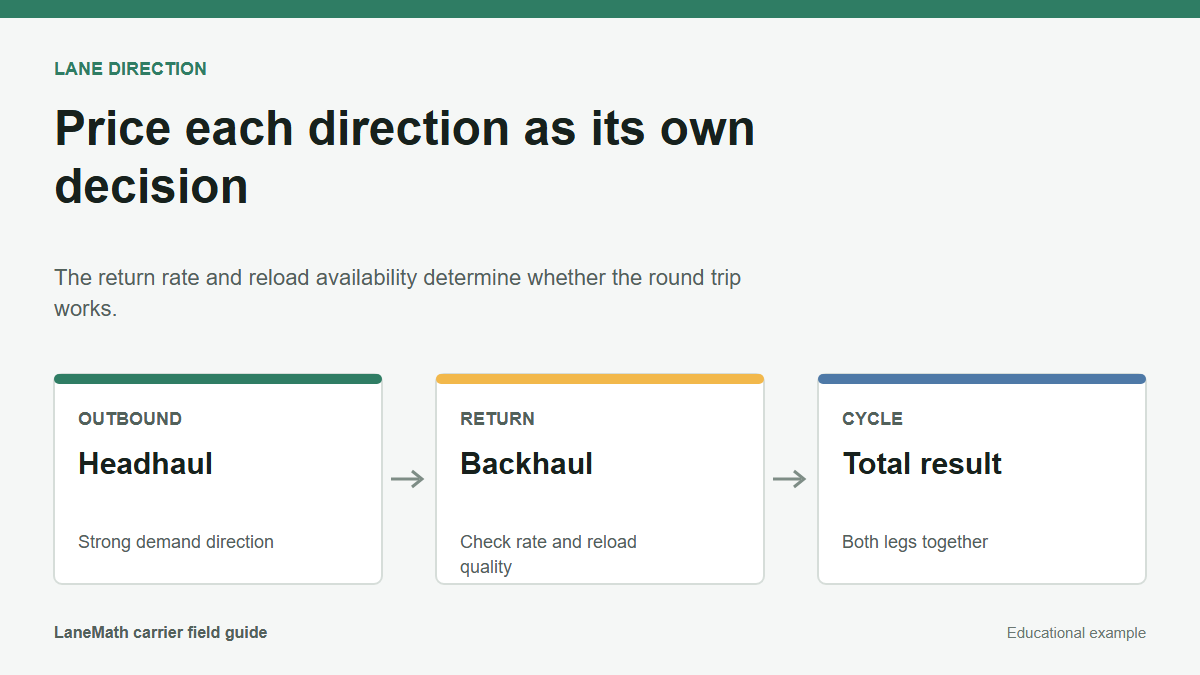
Directional lane review table
The headhaul direction and the backhaul direction should each be reviewed against volume, rate, and reload quality before accepting a round-trip plan.
| Signal | Why it matters | Next check |
|---|---|---|
| More loads posted in one direction | Volume imbalance suggests that direction has stronger demand. | Check whether the higher-volume direction also has stronger rates. |
| Rates differ significantly by direction | One direction may be structurally weaker for the carrier's equipment. | Price the lower-rate direction as a separate business decision. |
| Return direction has thin reload options | The carrier may face a repositioning cost or rate concession to reload. | Estimate that cost before accepting the outbound load. |
| Pattern shifts in seasonal period | Agricultural, retail, or industrial cycles change directional balance. | Adjust rate thresholds rather than relying on the prior season's pattern. |
Key takeaways
- Look at both directions before accepting a round-trip plan.
- Ask how many similar loads are posted, not just one attractive rate.
- Keep appointment risk in the lane comparison.
Working frame for headhaul vs backhaul lanes
A carrier-oriented look at why one direction of a lane may behave differently than the opposite direction, with attention to empty miles, appointment pressure, cost exposure, and the next move after delivery. The first operating question is whether the subject changes money, time, equipment fit, payment exposure, or the truck's position after delivery. Keep those effects separate so one attractive number does not hide an unresolved condition.
Checks before the truck is committed
Look at both directions before accepting a round-trip plan. Ask how many similar loads are posted, not just one attractive rate. Keep appointment risk in the lane comparison. Write down any term that still depends on a broker reply before dispatch. Confirm the exact commodity, weight, equipment, appointments, facility rules, and approval path that apply to this load rather than relying on a familiar lane or broker relationship.
Operating note
Headhaul and backhaul language is a directional lens. The same city pair can feel strong one way and difficult the other way because freight volume, equipment mix, appointment timing, and receiver locations differ. When reviewing a lane, compare the outbound move, the return move, and the nearby reload markets separately. A carrier should also notice whether the destination leaves the truck in a practical freight cluster or in a place where one weak reload can erase the benefit of the first load.
Which direction has the scheduling leverage?
Check how many suitable loads appear in each direction, how far pickups sit from the delivery cluster, and whether appointment times let the truck use that freight. Ask whether a strong direction is seasonal or tied to a small set of facilities. Directional strength can change without the highway distance changing at all.
A lane label can become stale
Calling one direction the headhaul can turn into a shortcut that replaces current planning. A weather event, produce season, plant shutdown, or holiday schedule can temporarily change truck availability and reload timing. The label is useful context, but it is not a rate quote or a guarantee for the day being booked.
Keep directional notes
Record offers and usable reload options separately for each direction. Include pickup radius, delivery radius, appointment quality, and actual empty miles. Over several trips, those notes show whether the supposed headhaul advantage survives the carrier's equipment and operating schedule.
Example scenario
Chicago to Atlanta may show a stronger outbound offer than Atlanta to Chicago on a particular week. If the southbound delivery lands late Friday and northbound freight does not pick up until Monday, the directional advantage may disappear in calendar time. The carrier has to price the weekend exposure. The numbers and circumstances are educational examples; replace them with the actual route, written terms, costs, and operating limits for the load being considered.
What to check before booking
- Look at both directions before accepting a round-trip plan.
- Ask how many similar loads are posted, not just one attractive rate.
- Keep appointment risk in the lane comparison.
- Write down any term that still depends on a broker reply before dispatch.
Common questions
How can a carrier tell which direction is the headhaul on a lane?
Headhaul and backhaul differ by freight density, load board volume, and typical posted rates. A carrier can compare the number of postings for each direction, watch where rates run stronger, and notice which direction the truck sits longer without options. The answer can shift by season, so periodic checks are more reliable than assuming the headhaul stays fixed year-round.
Should a carrier avoid backhaul lanes entirely?
Not necessarily. A backhaul can make sense when it avoids a longer empty move, keeps the truck productive, or positions the carrier for a stronger next load. The problem is accepting backhaul freight priced too low to cover fuel and then being left in a poor reload position at the far end.
Does the distinction between headhaul and backhaul affect how a carrier should price a load?
Yes, in that the return direction matters for the overall trip economics. A headhaul load that delivers into a strong reload market has different value than one that delivers into a thin market. Pricing only the outbound move without considering the return direction can result in accepting a load that looks fine on gross but creates a positioning problem after delivery.
How do headhaul rates and backhaul rates typically differ on the same corridor?
The spread varies by lane, season, and freight type. Some corridors run close to parity; others show a meaningful difference in rates and available volume. Carriers who work a corridor regularly develop a sense for which weeks the backhaul gets tighter, which months the headhaul softens, and when to adjust the rate threshold accordingly.
References and methodology
- Operational Costs of Trucking - American Transportation Research Institute. Used here for: Per-mile carrier operational cost context for educational rate, fuel, and profitability examples.Annual industry report used for general cost-structure background. Not a source for lane-specific rates or broker pricing. Last checked 2026-06-29.
- Freight Management and Operations - Federal Highway Administration. Used here for: Federal highway freight route, corridor planning, and infrastructure context for lane economics and routing discussions.Used for general freight infrastructure and route context only. Not a source for market rates, lane pricing, or broker data. Last checked 2026-06-29.
- Lane planning methodology - LaneMath Editorial Desk. Used here for: Example-only lane economics, deadhead questions, accessorial checks, and planning prompts.Methodology source for practical examples. It is not freight pricing data, load board data, or a broker quote source. Last checked 2026-06-29.