Good load vs bad load guide
A load-selection guide to a practical review before a carrier commits a truck, built around what to ask, what to verify, and what to write down before the truck moves.
Written and reviewed by LaneMath Editorial Team, with carrier workflow review from Dale Morrow where practical dispatch, paperwork, or lane-planning context is involved. Updated 2026-06-29. LaneMath pages use public references, example-only math, and conservative editorial review.
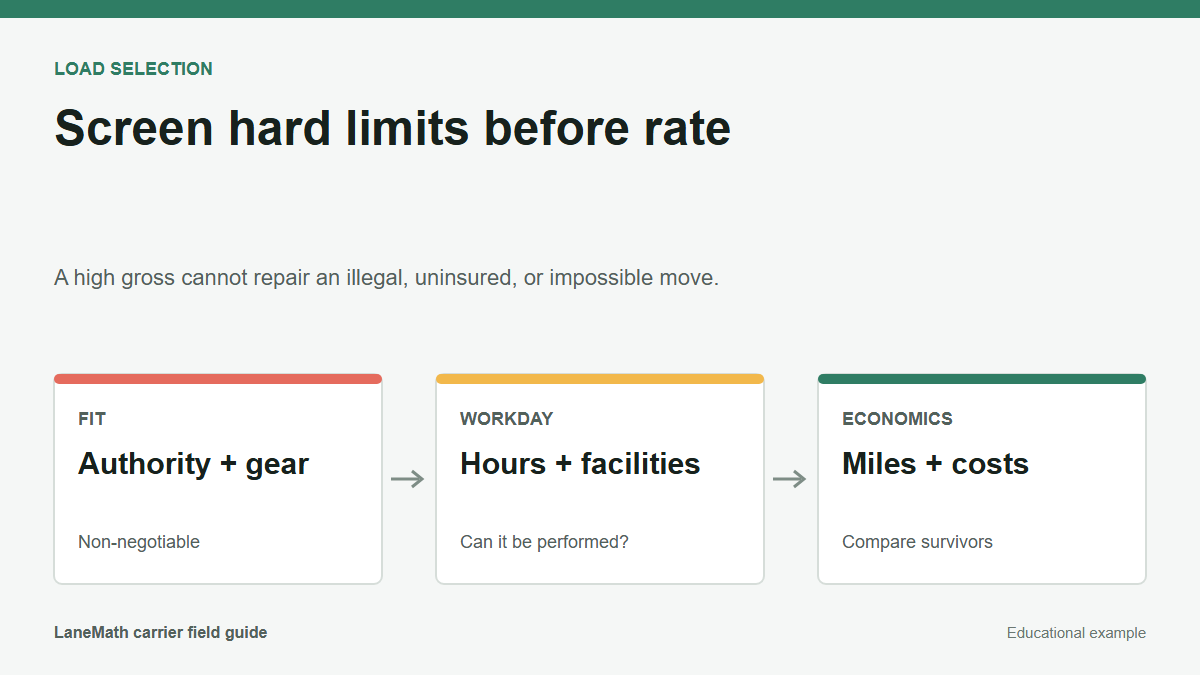
Load selection order
Screen non-negotiable fit first. Compare economics only among loads the carrier can actually perform and bill.
| Signal | Why it matters | Next check |
|---|---|---|
| Authority or insurance mismatch | Rate cannot fix a service the carrier is not permitted or insured to perform. | Decline or obtain professional clarification before dispatch. |
| Appointment cannot be met | The load begins with a known service failure. | Request a confirmed change before accepting. |
| Payment path is unclear | A clean delivery can still become a cash-flow problem. | Verify broker identity, terms, and invoice route. |
| Economics are close | Timing, facility history, and reload position become useful tie-breakers. | Write one sentence describing the main downside of each option. |
Key takeaways
- Check revenue, total miles, timing, broker credit, and reload options together.
- Look for hidden cost or vague accessorial terms.
- Decline loads that do not fit your authority, equipment, or risk tolerance.
Working frame for good load vs bad load guide
A load-selection guide to a practical review before a carrier commits a truck, built around what to ask, what to verify, and what to write down before the truck moves. The first operating question is whether the subject changes money, time, equipment fit, payment exposure, or the truck's position after delivery. Keep those effects separate so one attractive number does not hide an unresolved condition.
Checks before the truck is committed
Check revenue, total miles, timing, broker credit, and reload options together. Look for hidden cost or vague accessorial terms. Decline loads that do not fit your authority, equipment, or risk tolerance. Write down any term that still depends on a broker reply before dispatch. Confirm the exact commodity, weight, equipment, appointments, facility rules, and approval path that apply to this load rather than relying on a familiar lane or broker relationship.
Operating note
A good-load review combines money, time, risk, and next position. One load may look strong because the gross number is high, while another wins because the receiver is reliable and the reload market is better. Use the checklist to sort non-negotiables first: authority fit, insurance fit, equipment fit, and payment risk. Then compare the loads that remain by total miles, appointment quality, paperwork clarity, and dispatch recovery time.
Does the load fit this truck today?
Check legal and insurance fit first, then truck location, hours, trailer condition, cash exposure, broker payment, appointments, and the next move. A load can be good for another carrier and wrong for the truck being dispatched. Ask which single issue would turn the offer into a no.
One strong feature cannot rescue every weakness
High gross, short miles, a familiar broker, or a homebound direction can each dominate the decision. The risk is using that one benefit to excuse missing pickup information, weak payment confidence, unsuitable equipment, or an impossible schedule. Non-negotiable failures should be screened before rate comparison.
Keep a short acceptance reason
Save the confirmation and a brief note covering total miles, timing, payment path, main risk, and reload plan. If the load is declined, keep a one-line reason when useful. Repeated notes reveal whether the operation is consistently accepting the same avoidable problem.
Example scenario
A high-paying load moves the truck toward home but requires a pickup the driver cannot legally reach and offers no clear rescheduling option. The homebound direction does not fix the hours problem. A lower offer with a workable appointment may be the better business decision. The numbers and circumstances are educational examples; replace them with the actual route, written terms, costs, and operating limits for the load being considered.
What to check before booking
- Check revenue, total miles, timing, broker credit, and reload options together.
- Look for hidden cost or vague accessorial terms.
- Decline loads that do not fit your authority, equipment, or risk tolerance.
- Write down any term that still depends on a broker reply before dispatch.
Common questions
Is a higher gross revenue always the better load?
Not necessarily. Higher gross can be weakened by long deadhead to pickup, high fuel, tight appointments, heavy loads requiring driver assist, a poor reload market, or payment terms that create cash flow risk. The full trip — including empty miles and what comes after delivery — tells a more complete story.
What factor do carriers most often overlook in the load decision?
The reload plan. Accepting a well-paying outbound load into a weak freight market can turn a strong-looking rate into a difficult week. Checking delivery-area freight density before accepting is part of the same decision.
How do I identify a bad load when the gross rate looks fine?
Look for the things the rate does not show: an unverified broker, a pickup that changes details repeatedly, a destination with limited freight options, unusual accessorial requirements without written approval language, or an appointment that leaves the truck waiting overnight in an area without practical parking. The rate is visible on the posting; the problems usually are not.
At what point is a load clearly bad enough to decline without hesitation?
When the carrier cannot legally perform the service — authority, equipment, insurance, or compliance mismatch — the answer is no regardless of rate. When broker identity cannot be verified, when paperwork does not match the load described, or when cost math shows the load does not cover trip expenses, those are clear declines. Close calls require judgment; clear violations do not.
References and methodology
- Broker Registration - Federal Motor Carrier Safety Administration. Used here for: Broker authority and registration background.Used as a public reference for broker basics. Last checked 2026-06-29.
- Operational Costs of Trucking - American Transportation Research Institute. Used here for: Per-mile carrier operational cost context for educational rate, fuel, and profitability examples.Annual industry report used for general cost-structure background. Not a source for lane-specific rates or broker pricing. Last checked 2026-06-29.
- Load comparison example methodology - LaneMath Editorial Desk. Used here for: Example-only load comparison, weekly freight planning, reload uncertainty, and equipment-specific economics.Used for static planning examples based on carrier-entered assumptions, not pricing feeds or market forecasts. Last checked 2026-06-29.