Questions to ask before booking a load
A load-selection guide to the phone or email questions that protect a carrier before dispatch, built around what to ask, what to verify, and what to write down before the truck moves.
Written and reviewed by LaneMath Editorial Team, with carrier workflow review from Dale Morrow where practical dispatch, paperwork, or lane-planning context is involved. Updated 2026-06-29. LaneMath pages use public references, example-only math, and conservative editorial review.
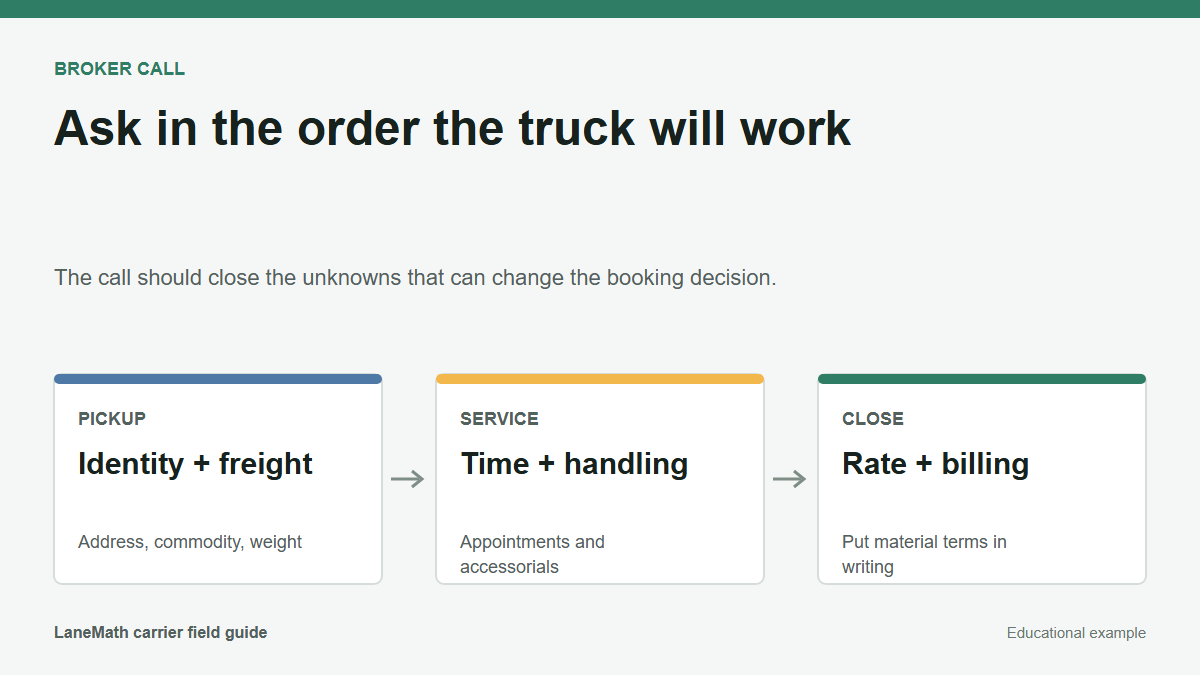
Broker-call question map
The best questions are the ones whose answers can change whether the carrier accepts the load.
| Signal | Why it matters | Next check |
|---|---|---|
| Pickup details are broad | The truck cannot plan approach miles or check-in without exact information. | Ask for address, pickup number, appointment type, commodity, and weight. |
| Extra work is possible | Lumper, driver assist, stops, or tracking may change cost and time. | Confirm approval rules and whether pay is included. |
| Delivery timing is uncertain | An open appointment can become a layover or lost reload. | Ask who controls scheduling and when it will be confirmed. |
| Call and document differ | Dispatch and billing need one working agreement. | Request a corrected confirmation before the truck moves. |
Key takeaways
- Ask about appointment, commodity, weight, equipment, facility rules, and accessorial approval.
- Confirm payment terms and documents required for billing.
- Put material changes in writing.
Working frame for questions to ask before booking a load
A load-selection guide to the phone or email questions that protect a carrier before dispatch, built around what to ask, what to verify, and what to write down before the truck moves. The first operating question is whether the subject changes money, time, equipment fit, payment exposure, or the truck's position after delivery. Keep those effects separate so one attractive number does not hide an unresolved condition.
Checks before the truck is committed
Ask about appointment, commodity, weight, equipment, facility rules, and accessorial approval. Confirm payment terms and documents required for billing. Put material changes in writing. Write down any term that still depends on a broker reply before dispatch. Confirm the exact commodity, weight, equipment, appointments, facility rules, and approval path that apply to this load rather than relying on a familiar lane or broker relationship.
Operating note
Before booking, the best questions are specific enough to change the decision. Ask for the pickup number, appointment type, commodity, weight, facility rules, required tracking, accessorial approval process, payment terms, and billing documents. The goal is not to interrogate the broker; it is to discover whether the load fits the truck. A short written recap after the call can prevent later disputes about what was promised.
Write the list before you call
The questions that protect a carrier are usually not discovered during the broker call — they are known before it. The useful habit is writing down, ahead of time, the two or three answers that would make the load a no. That might be a late pickup window, a lumper policy that requires upfront payment, a thin reload market, or a broker the carrier has not worked with before. That short list keeps the call from turning into a general information session that ends without a clear decision.
Ask the questions that can change the answer
Cover exact locations, pickup number, appointments, commodity, weight, equipment, tracking, facility rules, accessorial approval, rate structure, broker identity, and billing documents. Prioritize the two or three unknowns that would make the load unacceptable rather than reading a long script without listening.
A complete call can still leave the wrong gaps
Dispatchers sometimes collect many details but never ask when detention begins, whether a lumper needs preapproval, or if the delivery appointment is confirmed. Another mistake is asking the right question and failing to compare the answer with the confirmation that arrives later.
Turn the call into a usable load note
Record the broker contact, load number, confirmed facts, unresolved items, and any promise that affects money or timing. When the confirmation arrives, close or flag each open item. The note should help the driver and billing team without requiring them to replay the entire conversation.
Example scenario
A broker call covers rate and mileage, but the dispatcher asks one more question about receiver handling. The load requires a lumper paid by the carrier and reimbursed only with prior approval. That answer changes the cash requirement and the paperwork plan before booking. The numbers and circumstances are educational examples; replace them with the actual route, written terms, costs, and operating limits for the load being considered.
What to check before booking
- Ask about appointment, commodity, weight, equipment, facility rules, and accessorial approval.
- Confirm payment terms and documents required for billing.
- Put material changes in writing.
- Write down any term that still depends on a broker reply before dispatch.
Common questions
What is the most important topic to cover before booking?
There is not one single topic; the most useful pre-booking calls cover at least five areas — pickup address and number, delivery appointment type, commodity and weight, accessorial approval process, and payment terms. Missing any of those can create a dispatch or billing problem.
Should questions be asked before or after receiving the rate confirmation?
Both. Ask the important questions on the call before committing, then verify that the written confirmation matches what was discussed. A verbal agreement that differs from the confirmation needs to be resolved before the truck moves.
What questions are most commonly skipped that cause problems later?
Accessorial approval process and exact delivery appointment type. Carriers often confirm gross, miles, and general timing but skip asking who approves detention or lumper, what the cutoff time is at the facility, and whether a late arrival triggers a reschedule. Those gaps surface at the dock when there is no time to go back to the broker.
Is there a minimum set of questions that applies to every load regardless of type?
At a minimum: full pickup and delivery addresses, appointment time and type, commodity and estimated weight, equipment requirements, and payment terms. Beyond that, the useful questions vary by load. A live unload needs lumper and dwell questions; a temp-controlled load needs set-point and seal questions; an unfamiliar broker needs credit and billing questions.
References and methodology
- Broker Registration - Federal Motor Carrier Safety Administration. Used here for: Broker authority and registration background.Used as a public reference for broker basics. Last checked 2026-06-29.
- Broker negotiation editorial methodology - LaneMath Editorial Desk. Used here for: Broker call preparation, rate discussion, appointment changes, written confirmations, and walk-away decision examples.Used for practical negotiation education. It does not provide legal advice, pricing promises, or broker recommendations. Last checked 2026-06-29.