When to walk away from a load
A load-selection guide to spotting freight that does not fit the carrier's equipment, paperwork, timing, payment risk, or reload plan, built around what to ask, what to verify, and what to write down before the truck moves.
Written and reviewed by LaneMath Editorial Team, with carrier workflow review from Dale Morrow where practical dispatch, paperwork, or lane-planning context is involved. Updated 2026-06-29. LaneMath pages use public references, example-only math, and conservative editorial review.
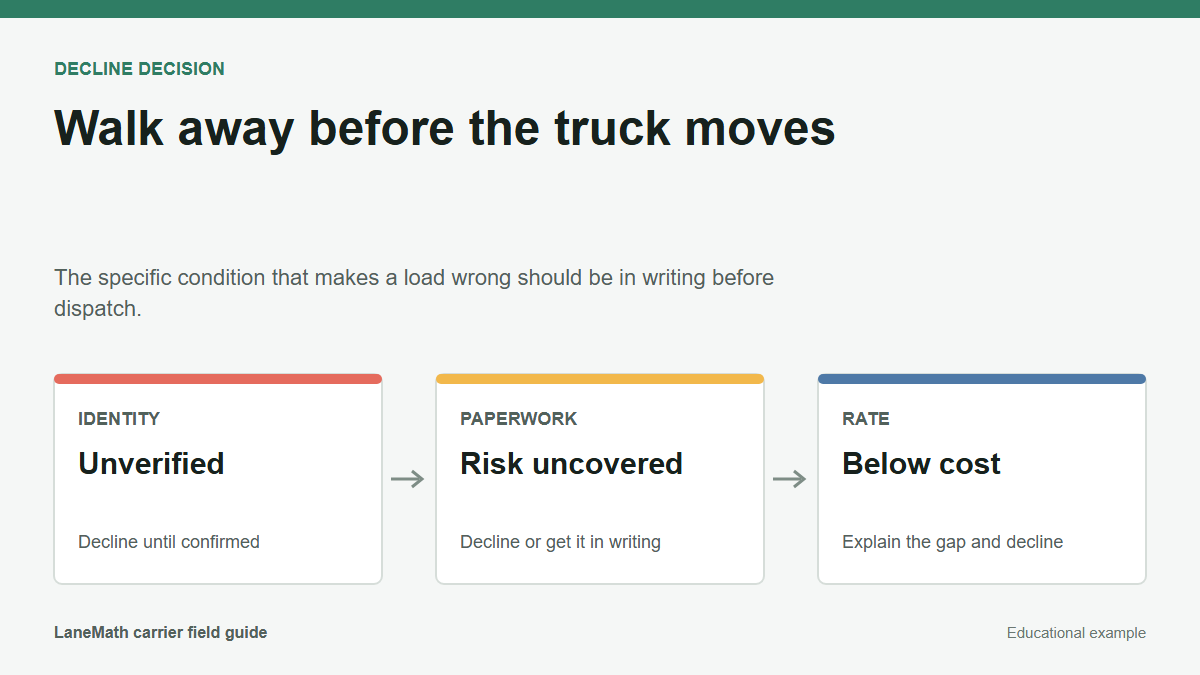
Load decline decision table
The decision to decline should be based on specific, documentable conditions rather than general discomfort with the load.
| Signal | Why it matters | Next check |
|---|---|---|
| Broker identity cannot be confirmed | Unverified identity creates payment, cargo, and fraud exposure. | Decline until identity is confirmed through an independent source. |
| Paperwork does not cover a known risk | A risk identified before dispatch but not addressed in writing will be disputed after delivery. | Ask for the written term before accepting, or decline the load. |
| Rate does not cover real trip costs | Accepting a load that does not cover costs does not improve over time. | Decline and explain the specific cost gap if the broker asks. |
| Confirmation differs from the call | The written terms control, not the verbal agreement. | Ask for a revision before signing, or walk away if the revision is refused. |
Key takeaways
- Watch vague pickup details, unclear accessorial terms, or mismatched broker information.
- Compare the offer against total miles, timing, and documents required.
- Decline freight that does not fit authority, insurance, equipment, or cash-flow tolerance.
Working frame for when to walk away from a load
A load-selection guide to spotting freight that does not fit the carrier's equipment, paperwork, timing, payment risk, or reload plan, built around what to ask, what to verify, and what to write down before the truck moves. The first operating question is whether the subject changes money, time, equipment fit, payment exposure, or the truck's position after delivery. Keep those effects separate so one attractive number does not hide an unresolved condition.
Checks before the truck is committed
Watch vague pickup details, unclear accessorial terms, or mismatched broker information. Compare the offer against total miles, timing, and documents required. Decline freight that does not fit authority, insurance, equipment, or cash-flow tolerance. Write down any term that still depends on a broker reply before dispatch. Confirm the exact commodity, weight, equipment, appointments, facility rules, and approval path that apply to this load rather than relying on a familiar lane or broker relationship.
Which problem cannot be priced or controlled?
Look for identity mismatches, illegal or uninsured service, unsuitable equipment, impossible timing, unclear commodity, weak payment confidence, or refusal to put material terms in writing. Some risks can be priced; others make the load unacceptable regardless of gross revenue.
Time invested can keep a bad call alive
After twenty minutes of negotiation, a dispatcher may accept new uncertainty simply to avoid losing the effort already spent. Another mistake is treating every concern as a request for more money. A higher rate does not repair false identity, prohibited cargo, missing authority, or a schedule the driver cannot legally meet.
Record a useful decline reason
When appropriate, note the broker, load reference, date, and specific reason the freight was declined. Keep verification evidence for identity or payment concerns. Avoid subjective labels; a factual note such as equipment mismatch or appointment cannot be met helps future dispatch decisions.
Example scenario
A broker increases the offer twice but will not identify the commodity beyond general merchandise, while the confirmation includes a cargo description the carrier's insurer excludes. The correct response is to decline, not to keep negotiating the price. The numbers and circumstances are educational examples; replace them with the actual route, written terms, costs, and operating limits for the load being considered.
What to check before booking
- Watch vague pickup details, unclear accessorial terms, or mismatched broker information.
- Compare the offer against total miles, timing, and documents required.
- Decline freight that does not fit authority, insurance, equipment, or cash-flow tolerance.
- Write down any term that still depends on a broker reply before dispatch.
Common questions
What is the clearest sign that a carrier should decline a load?
When the load requires accepting terms not in writing, the broker identity does not match verified records, the paperwork does not cover a known risk, or the carrier's real costs and timeline are not covered by the offered rate. Each of these is a specific, documentable reason — not a vague instinct about the load.
Is it unprofessional to decline a load after reviewing the confirmation?
No. Declining a load that does not match the truck's authority, insurance, equipment requirements, paperwork standards, or business criteria is a normal part of carrier operations. Reviewing loads carefully and declining ones that do not fit reduces risk for the carrier and the eventual shipper.
Can walking away from a load damage the relationship with a broker?
A professional, clear decline typically does not damage a relationship. The explanation matters more than the decision. A carrier who declines because the load does not fit their equipment, timeline, or rate criteria is providing useful information. A carrier who verbally commits, then backs out after receiving the confirmation, or who gives vague or inconsistent reasons, creates a different impression.
What is the best way to decline a load once the rate confirmation has already been sent?
Contact the broker promptly, before the truck is dispatched, and state the specific reason clearly. Waiting to decline after the broker has arranged pickup creates a coverage problem for the shipper. An early, specific decline — before dispatch — gives the broker time to find an alternative. That handling is better for the relationship than a last-minute back-out.
References and methodology
- Broker negotiation editorial methodology - LaneMath Editorial Desk. Used here for: Broker call preparation, rate discussion, appointment changes, written confirmations, and walk-away decision examples.Used for practical negotiation education. It does not provide legal advice, pricing promises, or broker recommendations. Last checked 2026-06-29.
- Payment-risk editorial methodology - LaneMath Editorial Desk. Used here for: Broker credit, quick pay, factoring, and documentation explanations that rely on practical workflow context.Used for educational payment workflow discussion. It is not financial, legal, credit, or factoring advice. Last checked 2026-06-29.