Loaded miles vs total miles
A carrier-oriented look at why empty miles can change the real economics of a load, with attention to empty miles, appointment pressure, cost exposure, and the next move after delivery.
Written and reviewed by LaneMath Editorial Team, with carrier workflow review from Dale Morrow where practical dispatch, paperwork, or lane-planning context is involved. Updated 2026-06-29. LaneMath pages use public references, example-only math, and conservative editorial review.
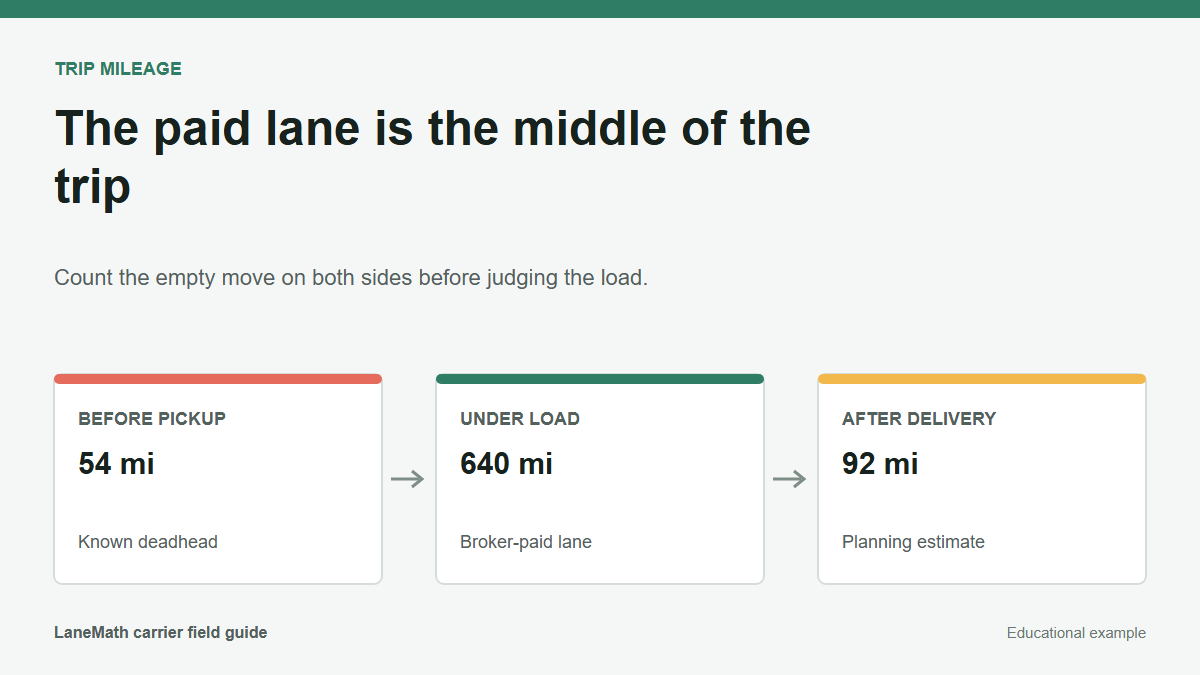
Three-part mileage review
The practical mileage total begins at the truck and ends where the truck can usefully continue.
| Signal | Why it matters | Next check |
|---|---|---|
| Pickup city is close | The exact warehouse may sit across the metro from the truck. | Route from the current truck position to the full pickup address. |
| Broker lists paid miles | The number explains the tender but not every mile the truck will operate. | Keep paid miles as a separate line in the calculation. |
| Receiver is outside the freight cluster | Delivery may create an empty move before another suitable pickup. | Estimate receiver-to-reload distance as a range. |
| Reload is only a possibility | Visible freight can disappear or conflict with the delivery time. | Test the outbound load with a fallback repositioning plan. |
Key takeaways
- Count realistic deadhead to pickup and after delivery.
- Compare gross per loaded mile with gross per total mile.
- Avoid treating map miles as a final operating plan.
Working frame for loaded miles vs total miles
A carrier-oriented look at why empty miles can change the real economics of a load, with attention to empty miles, appointment pressure, cost exposure, and the next move after delivery. The first operating question is whether the subject changes money, time, equipment fit, payment exposure, or the truck's position after delivery. Keep those effects separate so one attractive number does not hide an unresolved condition.
Checks before the truck is committed
Count realistic deadhead to pickup and after delivery. Compare gross per loaded mile with gross per total mile. Avoid treating map miles as a final operating plan. Write down any term that still depends on a broker reply before dispatch. Confirm the exact commodity, weight, equipment, appointments, facility rules, and approval path that apply to this load rather than relying on a familiar lane or broker relationship.
Operating note
For loaded miles versus total miles, build the comparison from the truck's actual starting point and likely ending position. A posted load may show only the paid lane, but the truck still has approach miles, fuel stops, parking decisions, and a reload search after delivery. This topic is most useful when a dispatcher writes three numbers side by side: paid miles, empty miles before pickup, and empty miles needed after delivery. If the empty-miles estimate changes, the load decision may change even when the broker rate stays the same.
Where carriers often undercount
The easy miss is the delivery-side empty move. A carrier may count 40 miles to pickup and forget the 120 miles needed after delivery to reach freight that actually fits the truck. That second number belongs in the decision even when it is less certain. Put it in as an estimate and mark it as an estimate; leaving it out makes the load look cleaner than it is.
Where does the truck start and finish?
Begin with the truck's actual position, not the city shown on the posting. Count the empty move to the shipper, the paid move, and a realistic path from the receiver to parking, home, or the next freight cluster. Ask whether the appointment timing makes that final move possible on the same day.
Delivery-side miles are easy to forget
Approach deadhead is visible because the truck must reach pickup. Repositioning after delivery is less certain, so it is often left out completely. That makes an outbound load look better precisely where the estimate is weakest. A reasonable range is more honest than zero when the destination routinely requires a move to find suitable freight.
Keep three mileage lines
Record empty miles before pickup, loaded miles, and estimated empty miles after delivery as separate numbers. Note the mapping source and whether the final leg is a firm plan or a range. When the actual trip closes, compare the estimate with dispatch mileage to improve the next decision on a similar lane.
Example scenario
A load shows 640 paid miles. The truck is 54 miles from pickup, and the receiver is about 92 miles from the carrier's preferred reload area. The planning total is 786 miles, not 640. If a reload appears beside the receiver, the estimate improves; the decision file should show that this was the uncertainty. The numbers and circumstances are educational examples; replace them with the actual route, written terms, costs, and operating limits for the load being considered.
What to check before booking
- Count realistic deadhead to pickup and after delivery.
- Compare gross per loaded mile with gross per total mile.
- Avoid treating map miles as a final operating plan.
- Write down any term that still depends on a broker reply before dispatch.
Common questions
Why do total miles matter if the broker pays loaded miles?
The truck still burns fuel and time while driving empty. Total miles help carriers compare the full trip, including deadhead to pickup and likely repositioning after delivery.
What empty miles should be included?
Include realistic deadhead to pickup and any practical empty miles needed after delivery to reach the next usable freight market, home terminal, or parking plan.
How do I estimate post-delivery empty miles when I don't know where the next load will be?
Use the distance from the receiver to the nearest freight cluster that typically has equipment-compatible loads. A range is fine — use a conservative number and note it as an estimate. Leaving post-delivery miles out entirely tends to make the load look better than the full trip turns out to be.
Is there a standard rule for how many deadhead miles are acceptable before pickup?
There is no universal rule. Most carriers develop their own threshold based on load gross, fuel cost, and how quickly the truck can return to productive freight. The practical question is whether the deadhead-adjusted rate still makes the load worthwhile compared to waiting for something closer.
References and methodology
- Operational Costs of Trucking - American Transportation Research Institute. Used here for: Per-mile carrier operational cost context for educational rate, fuel, and profitability examples.Annual industry report used for general cost-structure background. Not a source for lane-specific rates or broker pricing. Last checked 2026-06-29.
- Industry terminology and editorial explanation - LaneMath Editorial Desk. Used here for: Plain-English definitions, checklists, and example-only calculations.Editorial explanations are not official guidance, legal advice, or market data. Last checked 2026-06-29.