Deadhead miles explained
A carrier-oriented look at how unpaid empty miles affect fuel, time, and rate decisions, with attention to empty miles, appointment pressure, cost exposure, and the next move after delivery.
Written and reviewed by LaneMath Editorial Team, with carrier workflow review from Dale Morrow where practical dispatch, paperwork, or lane-planning context is involved. Updated 2026-06-29. LaneMath pages use public references, example-only math, and conservative editorial review.
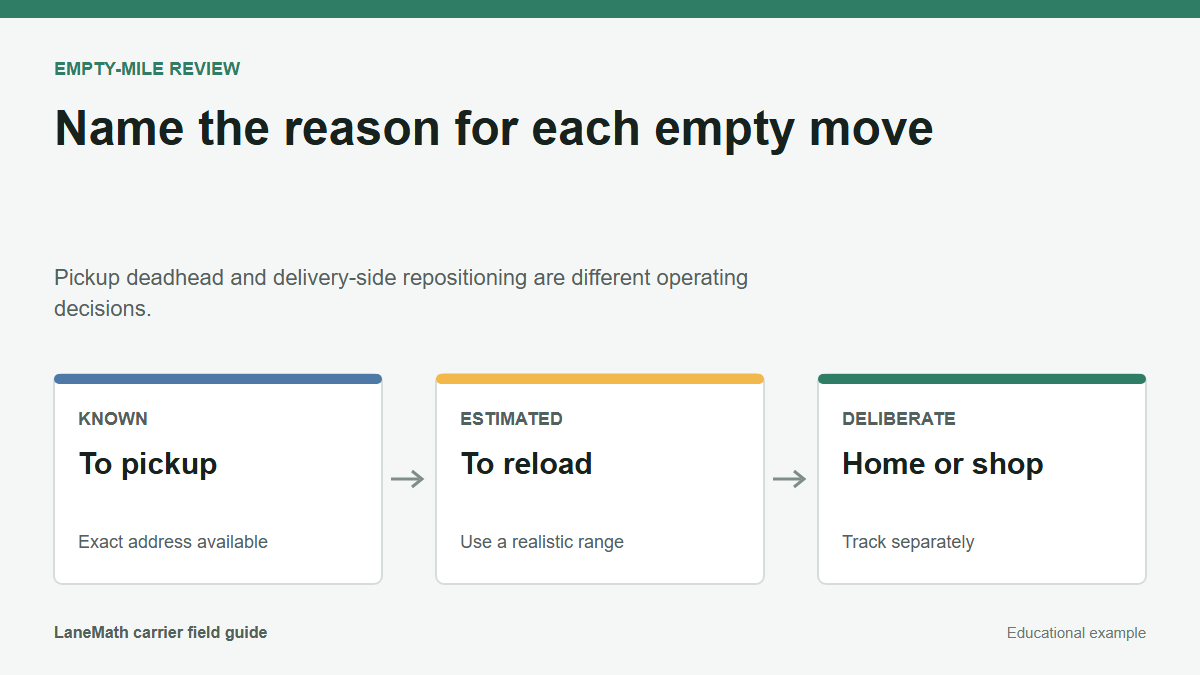
Deadhead purpose and response
The same number of empty miles can mean something different depending on why the truck is moving.
| Signal | Why it matters | Next check |
|---|---|---|
| Empty to pickup | The carrier is spending time and fuel before paid movement begins. | Include the exact approach in total-mile economics. |
| Empty after delivery | The load may end away from suitable freight, parking, or home. | Name the target area instead of using a general allowance. |
| Empty to a regular customer | The move may protect a stronger relationship or committed load. | Compare the whole sequence, not the empty leg alone. |
| Empty miles exceed the plan | A facility change, canceled reload, or routing choice altered the trip. | Record the cause so the next estimate can improve. |
Key takeaways
- Measure deadhead before pickup and likely repositioning after delivery.
- Price fuel and time into the load decision.
- Ask whether pickup or delivery timing creates extra unpaid miles.
Working frame for deadhead miles explained
A carrier-oriented look at how unpaid empty miles affect fuel, time, and rate decisions, with attention to empty miles, appointment pressure, cost exposure, and the next move after delivery. The first operating question is whether the subject changes money, time, equipment fit, payment exposure, or the truck's position after delivery. Keep those effects separate so one attractive number does not hide an unresolved condition.
Checks before the truck is committed
Measure deadhead before pickup and likely repositioning after delivery. Price fuel and time into the load decision. Ask whether pickup or delivery timing creates extra unpaid miles. Write down any term that still depends on a broker reply before dispatch. Confirm the exact commodity, weight, equipment, appointments, facility rules, and approval path that apply to this load rather than relying on a familiar lane or broker relationship.
Separate the two empty moves
Deadhead before pickup and repositioning after delivery are not the same problem. The first is usually known before booking. The second is an estimate based on where the truck can actually reload, park, fuel, or return home. Put those two numbers on separate lines. If they are blended together, the load can look cleaner than it is.
Is the empty move buying a better position?
Ask why the truck is running empty. Deadhead to a strong customer, home terminal, maintenance appointment, or a reliable freight area may be deliberate. Empty miles caused by a vague pickup location or a destination with no reload plan deserve different treatment. The purpose of the move matters as much as its length.
Not all empty miles belong in one bucket
Combining pickup deadhead, delivery-side repositioning, and personal home-time miles can make later comparisons misleading. The carrier may also count map distance but miss an out-of-route fuel stop or trailer move. Separate the reason for each empty leg so the next review can tell which miles were avoidable.
Track planned and actual empty miles
A dispatch note should show the starting location, pickup address, receiver address, planned reload area, and the empty miles assigned to each leg. After delivery, replace the estimate with actual mileage when it is available. That small feedback loop is more useful than relying on a general fleet deadhead percentage.
Example scenario
A carrier accepts 110 miles of deadhead to reach a shipper that regularly loads the truck toward home. The move may make sense even though another posting begins 25 miles away. The comparison must include the second load's receiver, appointment, and next position, not treat all deadhead as equally bad. The numbers and circumstances are educational examples; replace them with the actual route, written terms, costs, and operating limits for the load being considered.
What to check before booking
- Measure deadhead before pickup and likely repositioning after delivery.
- Price fuel and time into the load decision.
- Ask whether pickup or delivery timing creates extra unpaid miles.
- Write down any term that still depends on a broker reply before dispatch.
Common questions
What counts as deadhead mileage?
Deadhead miles are unpaid empty miles driven to reach a load pickup or after delivery to reach the next practical freight market or parking. Both the pre-pickup empty move and the post-delivery repositioning cost fuel and time without generating revenue.
Should post-delivery empty miles be estimated before booking?
Yes, even when the estimate is rough. Carriers often undercount post-delivery repositioning because it is uncertain at booking time. A conservative estimate — even marked as approximate — makes the full trip math more honest than leaving it out entirely.
How far is too much deadhead to pickup?
There is no universal cutoff. The useful question is whether the deadhead-adjusted gross per total mile still makes the load worthwhile compared to other available loads or staying put. A 60-mile empty move on a $3,000 load may be fine; the same 60 miles on a $600 short haul may not be. Each situation should be evaluated against the specific numbers.
Does the broker pay for deadhead miles in any circumstances?
Brokers generally do not pay for standard deadhead to pickup or after delivery repositioning. Some situations — such as a truck ordered not used (TONU), a load that is cancelled en route, or a special repositioning requirement that was written into the confirmation — may include compensation for empty miles. Those terms need to be in writing before the truck moves.
References and methodology
- Operational Costs of Trucking - American Transportation Research Institute. Used here for: Per-mile carrier operational cost context for educational rate, fuel, and profitability examples.Annual industry report used for general cost-structure background. Not a source for lane-specific rates or broker pricing. Last checked 2026-06-29.
- Gasoline and Diesel Fuel Update - U.S. Energy Information Administration. Used here for: Diesel price context for educational fuel surcharge examples.LaneMath tools do not pull live EIA data. Last checked 2026-06-29.
- Industry terminology and editorial explanation - LaneMath Editorial Desk. Used here for: Plain-English definitions, checklists, and example-only calculations.Editorial explanations are not official guidance, legal advice, or market data. Last checked 2026-06-29.