Dry van rate basics
A dispatch guide to common dry van factors that affect load value, focused on equipment requirements, facility details, accessorial exposure, and usable written instructions.
Written and reviewed by LaneMath Editorial Team, with carrier workflow review from Dale Morrow where practical dispatch, paperwork, or lane-planning context is involved. Updated 2026-06-29. LaneMath pages use public references, example-only math, and conservative editorial review.
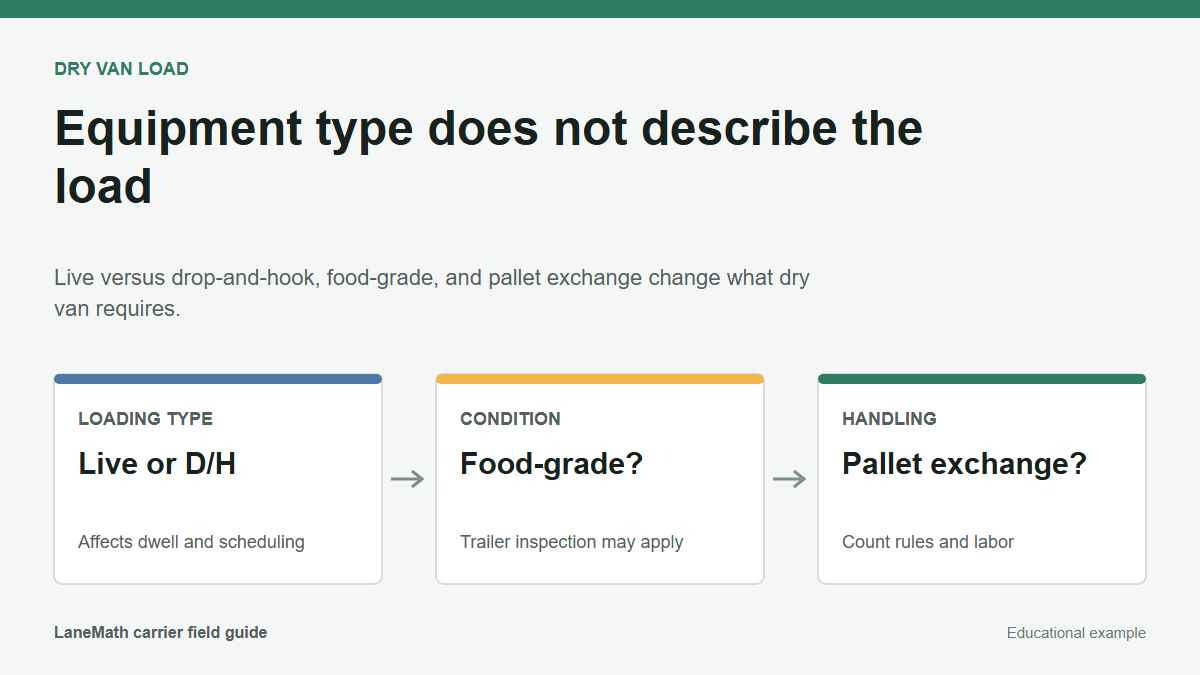
Dry van load review table
The dry van equipment type covers a wide range of freight requirements — the trailer is a starting point, not a complete description of the load.
| Signal | Why it matters | Next check |
|---|---|---|
| Load is listed as live unload | Live unloading creates dwell exposure that drop-and-hook does not. | Ask about typical facility wait time and whether detention applies. |
| Shipper mentions food-grade requirement | A trailer that fails inspection causes a missed pickup and potential TONU exposure. | Confirm trailer condition, odor, and documentation requirements before arrival. |
| Pallet exchange is required | Exchanging pallets adds labor and may require the driver to count and verify. | Confirm the exchange rules and whether that duty is included in the rate. |
| Weight is near 44,000 pounds | Freight near legal maximums requires weight verification before certain routes. | Confirm the weight and check whether specific bridge or axle restrictions apply on the route. |
Key takeaways
- Review weight, appointment times, drop or live load details, and reload market.
- Check whether driver assist or pallet exchange is required.
- Compare total-mile economics, not only posted gross.
Working frame for dry van rate basics
A dispatch guide to common dry van factors that affect load value, focused on equipment requirements, facility details, accessorial exposure, and usable written instructions. The first operating question is whether the subject changes money, time, equipment fit, payment exposure, or the truck's position after delivery. Keep those effects separate so one attractive number does not hide an unresolved condition.
Checks before the truck is committed
Review weight, appointment times, drop or live load details, and reload market. Check whether driver assist or pallet exchange is required. Compare total-mile economics, not only posted gross. Write down any term that still depends on a broker reply before dispatch. Confirm the exact commodity, weight, equipment, appointments, facility rules, and approval path that apply to this load rather than relying on a familiar lane or broker relationship.
Operating note
Dry van pricing looks simple until appointment, weight, drop/live handling, pallet exchange, and receiver rules are reviewed. A heavy dry-van load with a strict grocery appointment is a different decision from a light drop-and-hook move, even if the city pair is similar. Ask whether driver assist, seal procedures, trailer condition, or detention language changes the practical value. Dry van freight still needs written terms, not just a familiar trailer type.
What makes this dry-van load more than linehaul?
Confirm commodity, weight, trailer condition, seal rules, live or drop handling, pallet exchange, driver assist, appointment type, and receiver requirements. Ask whether a drop requires leaving the trailer and when an empty will be available. Familiar equipment does not make the service details ordinary.
The trailer may fit while the day does not
A legal dry-van load can still create an unworkable schedule through long live loading, strict retail delivery, or a delayed trailer return. Dispatchers also miss fuel impact when a heavy load and congested route are compared with a light drop-and-hook on mileage alone.
Keep trailer and handling details
Save trailer requirements, commodity, weight, seal instructions, pallet terms, appointments, and any driver-assist approval. For a drop, record trailer number, condition, interchange details, and expected recovery. Those facts belong beside the rate confirmation, not only in a driver text.
Example scenario
Two dry-van loads run 430 miles. One is a 20,000-pound drop-and-hook; the other is a 44,000-pound live load with pallet exchange and a grocery appointment. The second load needs different fuel, time, and accessorial assumptions even though the trailer category and mileage match. The numbers and circumstances are educational examples; replace them with the actual route, written terms, costs, and operating limits for the load being considered.
What to check before booking
- Review weight, appointment times, drop or live load details, and reload market.
- Check whether driver assist or pallet exchange is required.
- Compare total-mile economics, not only posted gross.
- Write down any term that still depends on a broker reply before dispatch.
Common questions
What is the most important factor in dry van rate decisions beyond miles?
Appointment type and receiver handling. A live unload with a strict appointment window, heavy freight, and driver-assist requirements is a materially different load from a drop-and-hook at the same mileage and gross. Both are dry van; neither has the same real value per loaded mile.
How does trailer condition affect dry van bookings?
Some dry van shippers reject trailers based on condition, cleanliness, seal integrity, or specific requirements like food-grade inspections. A rejected trailer means lost time and potential TONU exposure. Asking about equipment requirements before accepting is part of the load review.
What trailer length and weight specifications come up most often in dry van bookings?
Most standard dry van freight moves on 53-foot trailers with a legal gross vehicle weight of 80,000 pounds. Some shippers specify 48-foot trailers or limit weight below 45,000 pounds of freight for structural or facility reasons. Asking for commodity weight, pallet count, and any equipment restrictions before committing prevents surprises at the dock.
Is drop-and-hook dry van always better than live load?
Not automatically. Drop-and-hook is usually faster and produces less dwell exposure, but preloaded trailers can have condition or weight issues that a live load does not. A drop-and-hook at a congested yard where trailers are hard to locate can also create delays. The question is whether the specific drop-and-hook is clean and accessible, not whether the load type is inherently better.
References and methodology
- Operational Costs of Trucking - American Transportation Research Institute. Used here for: Per-mile carrier operational cost context for educational rate, fuel, and profitability examples.Annual industry report used for general cost-structure background. Not a source for lane-specific rates or broker pricing. Last checked 2026-06-29.
- Gasoline and Diesel Fuel Update - U.S. Energy Information Administration. Used here for: Diesel price context for educational fuel surcharge examples.LaneMath tools do not pull live EIA data. Last checked 2026-06-29.
- Industry terminology and editorial explanation - LaneMath Editorial Desk. Used here for: Plain-English definitions, checklists, and example-only calculations.Editorial explanations are not official guidance, legal advice, or market data. Last checked 2026-06-29.