Detention proof and documentation
A paperwork-first guide to building a factual record for detention requests using arrival time, free time, release time, written terms, and POD support, including the written terms and records that matter before dispatch and after delivery.
Written and reviewed by LaneMath Editorial Team, with carrier workflow review from Dale Morrow where practical dispatch, paperwork, or lane-planning context is involved. Updated 2026-06-29. LaneMath pages use public references, example-only math, and conservative editorial review.
Carrier review note
Dale's early detention requests were sometimes denied because his file showed that the truck waited but did not preserve a complete arrival-to-release timeline. His review of this guide focused on keeping appointment, check-in, delay notice, dock, and release records separate.
Detention documentation table
The detention file should tell a factual timeline that connects to the written terms in the confirmation.
| Signal | Why it matters | Next check |
|---|---|---|
| Appointment time is known | The appointment is the starting clock reference for most detention calculations. | Record arrival and check-in separately and note which the confirmation uses. |
| Free time expires without dock access | The detention clock begins at the end of written free time, not when the driver decides to request it. | Send a delay notification to the broker with a timestamp at that moment. |
| Broker does not respond to the notice | Silence is not approval, but a documented sent notification is stronger than no record. | Keep the sent message and time in the file with the other load documents. |
| Release time is unclear | An undocumented release time weakens the end of the detention window. | Ask the facility for a signed release note or record the departure time with a timestamp. |
Key takeaways
- Record arrival, dock time when known, and departure or release time.
- Match the request to the detention clause and free-time language.
- Send the request with POD, BOL, and written approval records.
Working frame for detention proof and documentation
A paperwork-first guide to building a factual record for detention requests using arrival time, free time, release time, written terms, and POD support, including the written terms and records that matter before dispatch and after delivery. The first operating question is whether the subject changes money, time, equipment fit, payment exposure, or the truck's position after delivery. Keep those effects separate so one attractive number does not hide an unresolved condition.
Checks before the truck is committed
Record arrival, dock time when known, and departure or release time. Match the request to the detention clause and free-time language. Send the request with POD, BOL, and written approval records. Write down any term that still depends on a broker reply before dispatch. Confirm the exact commodity, weight, equipment, appointments, facility rules, and approval path that apply to this load rather than relying on a familiar lane or broker relationship.
The detention file should tell a timeline
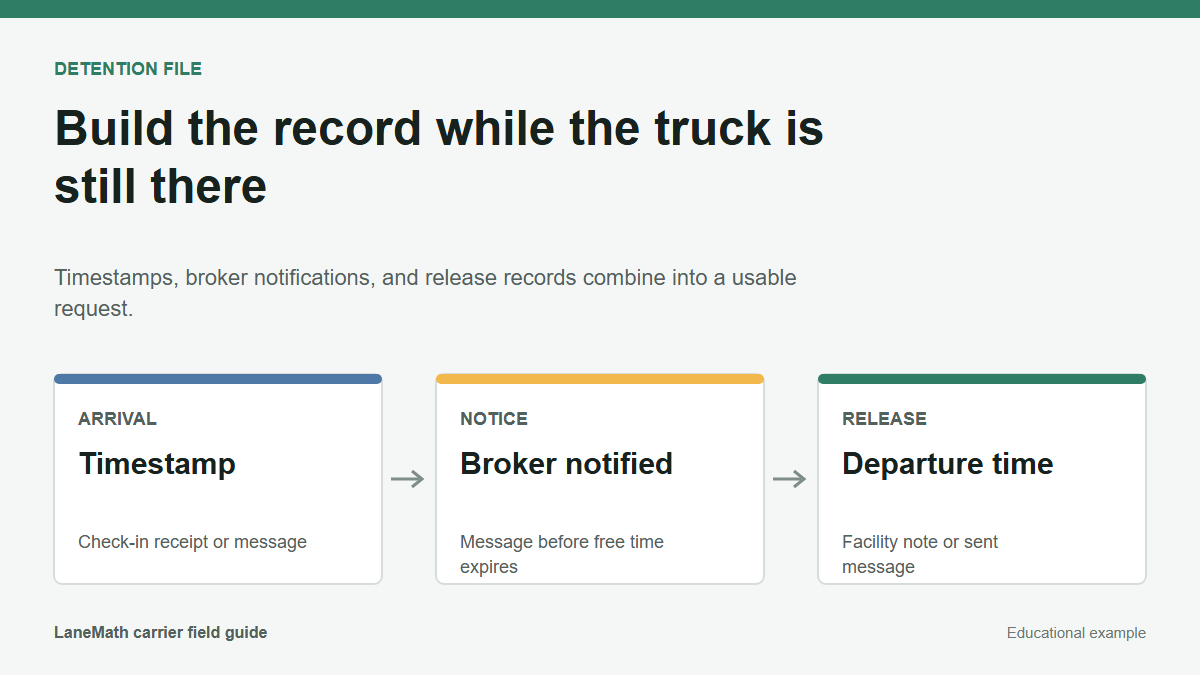
A good detention request reads like a timeline: appointment, arrival, check-in, delay notice, dock or wait status, release, and broker follow-up. It does not need drama. It needs timestamps, written terms, and enough context for someone in billing to understand what happened without calling the driver again.
Can the file show a complete delay timeline?
Identify appointment, arrival, check-in, free-time end, delay notices, dock status, release, and departure. Ask which timestamps the broker accepts and whether facility signatures or tracking records are required. The evidence should match the detention clause being used.
One timestamp rarely proves the whole request
A gate receipt may show arrival but not release, while a POD may show completion without check-in. Carriers also calculate from arrival when the confirmation starts free time at the appointment. The claim weakens when the requested hours and governing language use different clocks.
Arrange proof as a timeline
Keep the confirmation clause, appointment, gate or app timestamps, messages, BOL and POD notes, release record, approval, and requested calculation. Put events in order with time zones when relevant. Billing should be able to reproduce the claimed duration without calling the driver.
Example scenario
The truck arrives at 9:35 for a 10:00 appointment, checks in at 9:42, and leaves at 1:50. If free time starts at 10:00 and lasts two hours, the potential detention period begins at noon, not at 9:35. The file needs each time to show that calculation. The numbers and circumstances are educational examples; replace them with the actual route, written terms, costs, and operating limits for the load being considered.
What to check before booking
- Record arrival, dock time when known, and departure or release time.
- Match the request to the detention clause and free-time language.
- Send the request with POD, BOL, and written approval records.
- Write down any term that still depends on a broker reply before dispatch.
Common questions
What records support a detention request?
Useful records include appointment time, arrival time, dock or check-in notes, departure or release time, written load terms, broker approval, BOL, POD, and any facility timestamps.
When should detention be discussed with the broker?
The cleanest approach is to clarify free time and approval rules before pickup, then send delay updates while the truck is still on site if detention may apply.
What if the facility does not provide a written check-in timestamp?
Record the check-in yourself with a time-stamped message to the broker or a dispatch note, and photograph the signed BOL with a visible clock or phone timestamp. A self-generated record is weaker than a facility record but is better than no documentation at all. Noting the driver's arrival and the dock assignment time in a text or message to the broker creates a contemporaneous record.
Is free time typically 2 hours, or does it vary by broker?
Free time is set by the rate confirmation, not a universal standard. Confirmations use different allowances and different clock triggers, including appointment time, arrival, or check-in. Reading the written term before arrival is the only reliable way to know what applies on a specific load.
Can detention be billed if the broker never responded to the delay notice?
A lack of broker response does not automatically invalidate the charge if the confirmation language supports it, but it does complicate billing. Sending a follow-up message while still on site — noting the delay, asking for acknowledgment, and confirming the free-time clock — creates a record even if the broker does not respond immediately.
References and methodology
- Accessorial documentation editorial methodology - LaneMath Editorial Desk. Used here for: Detention, lumper, layover, TONU, revised confirmation, and post-delivery document workflow examples.Used for documentation workflows and example scenarios, not for legal claims about collectability. Last checked 2026-06-29.
- Rate confirmation educational reference - LaneMath Editorial Desk. Used here for: Educational discussion of rate confirmation review, revised confirmations, written approval, and document connections.Used for document literacy. It is not legal advice and does not replace professional review. Last checked 2026-06-29.