How to ask for detention terms before pickup
A paperwork-first guide to clarifying free time, detention clock language, approval steps, and records before the truck reaches the shipper, including the written terms and records that matter before dispatch and after delivery.
Written and reviewed by LaneMath Editorial Team, with carrier workflow review from Dale Morrow where practical dispatch, paperwork, or lane-planning context is involved. Updated 2026-06-29. LaneMath pages use public references, example-only math, and conservative editorial review.
Pre-pickup detention clarification table
Detention questions answered before the truck arrives are easier to use than questions raised after a delay has already started.
| Signal | Why it matters | Next check |
|---|---|---|
| Confirmation is silent on detention | Silence creates ambiguity on rate, trigger, and approval process. | Ask the broker to add detention language or confirm terms in writing. |
| Free time is one hour or less | Short free time creates detention exposure on any facility with modest volume. | Confirm the exact clock trigger and approval notification method. |
| Broker says detention is standard | Standard may mean different rates, triggers, and proof requirements. | Ask what standard means in writing on this specific load. |
| Facility is known for delays | Detention risk is higher when the receiver history includes long dwell. | Request a phone confirmation that covers delay updates and approval steps. |
Key takeaways
- Ask when free time starts and when the detention clock begins.
- Confirm whether arrival and departure records must be signed or messaged.
- Request written approval language before the delay happens when possible.
Working frame for how to ask for detention terms before pickup
A paperwork-first guide to clarifying free time, detention clock language, approval steps, and records before the truck reaches the shipper, including the written terms and records that matter before dispatch and after delivery. The first operating question is whether the subject changes money, time, equipment fit, payment exposure, or the truck's position after delivery. Keep those effects separate so one attractive number does not hide an unresolved condition.
Checks before the truck is committed
Ask when free time starts and when the detention clock begins. Confirm whether arrival and departure records must be signed or messaged. Request written approval language before the delay happens when possible. Write down any term that still depends on a broker reply before dispatch. Confirm the exact commodity, weight, equipment, appointments, facility rules, and approval path that apply to this load rather than relying on a familiar lane or broker relationship.
Ask before the clock exists
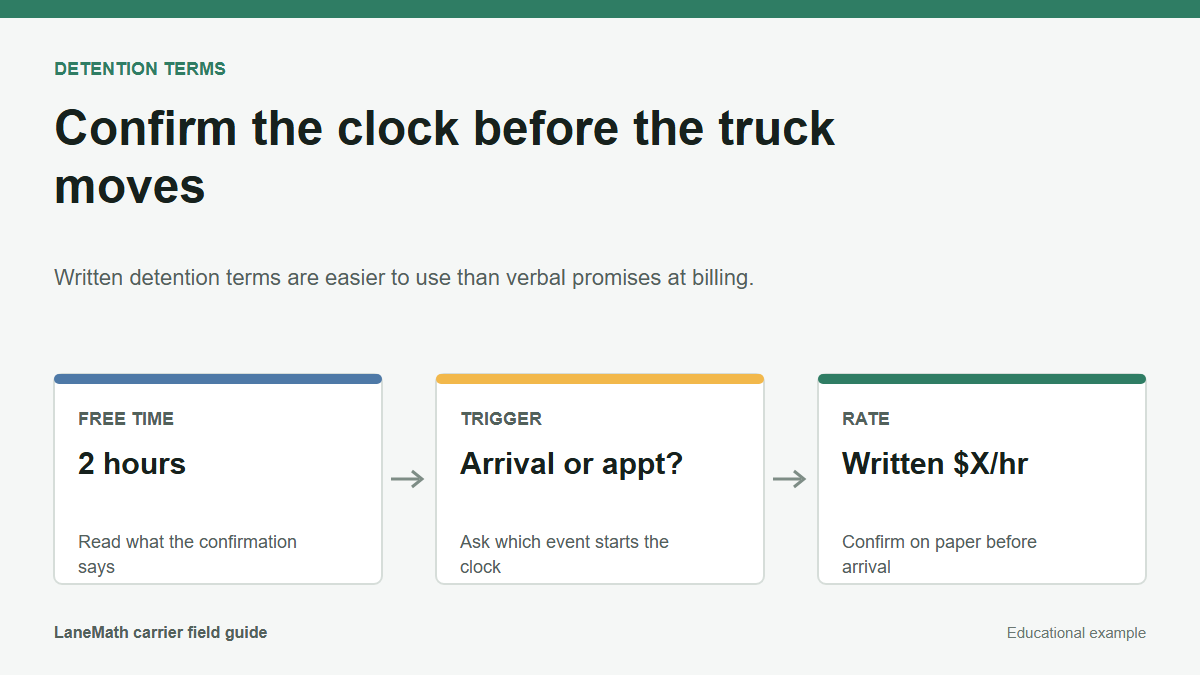
Detention is easier to clarify before the truck is at the dock. Ask when free time starts, what timestamp controls, who approves the request, and whether the broker wants delay notices while the truck is still on site. Once the delay is over, the discussion is mostly about proof.
When does detention begin, and who must be told?
Ask about appointment time, free time, clock start, hourly amount, maximum, notice deadline, required timestamps, and approval contact. Clarify whether FCFS freight is treated differently. The carrier should know what to do during the delay, not search for the rule after leaving the facility.
Asking about detention is not the same as securing terms
A broker may say detention is paid without stating free time or documentation. Carriers also wait until three hours have passed before sending the first notice, only to learn that the confirmation required notice at one hour. The process has to be understood before the event.
Put the clock rules in the load file
Keep the confirmation language, appointment, arrival and check-in evidence, delay notices, dock status, release time, BOL or POD notes, and written approval. A simple timeline makes the request easier to review than disconnected screenshots.
Example scenario
The broker says detention starts after two hours but requires notice after one. The truck checks in at 7:50 for an 8:00 appointment. Dispatch sends a delay notice at 9:00 and records release at 11:25, preserving both the notice rule and the time calculation. The numbers and circumstances are educational examples; replace them with the actual route, written terms, costs, and operating limits for the load being considered.
What to check before booking
- Ask when free time starts and when the detention clock begins.
- Confirm whether arrival and departure records must be signed or messaged.
- Request written approval language before the delay happens when possible.
- Write down any term that still depends on a broker reply before dispatch.
Common questions
What should a carrier ask about detention before the truck arrives at the facility?
Ask when free time starts, how long it runs, when the detention clock begins, what rate is written in the confirmation, and how delay notices should be sent. Having those answers before arrival makes the billing conversation more straightforward if a delay occurs.
Does asking about detention before pickup affect the broker relationship?
Clarifying written terms before arrival is a normal part of load preparation. Asking how detention works before the truck reaches the dock is more useful than trying to resolve it after a delay has already happened.
What if the rate confirmation is silent on detention — does that mean it is not available?
Silence in the confirmation creates ambiguity. A carrier can still request detention when delayed, but without written terms it is harder to establish the rate and trigger. Before pickup is the best time to ask the broker to clarify or add detention language. Getting a brief written response that states the rate and approval process is more useful than leaving the silence unresolved.
How should the driver communicate when the free time is about to expire at the facility?
A message to the broker with a timestamp, load number, and a note that the free time window is expiring creates a contemporaneous record. Keep it factual and short. Sending this message while the truck is still on site — not after departure — preserves the option to bill for actual dwell time.
References and methodology
- Accessorial documentation editorial methodology - LaneMath Editorial Desk. Used here for: Detention, lumper, layover, TONU, revised confirmation, and post-delivery document workflow examples.Used for documentation workflows and example scenarios, not for legal claims about collectability. Last checked 2026-06-29.
- Rate confirmation educational reference - LaneMath Editorial Desk. Used here for: Educational discussion of rate confirmation review, revised confirmations, written approval, and document connections.Used for document literacy. It is not legal advice and does not replace professional review. Last checked 2026-06-29.