Reefer rate basics
A dispatch guide to temperature-controlled load factors carriers should price into decisions, focused on equipment requirements, facility details, accessorial exposure, and usable written instructions.
Written and reviewed by LaneMath Editorial Team, with carrier workflow review from Dale Morrow where practical dispatch, paperwork, or lane-planning context is involved. Updated 2026-06-29. LaneMath pages use public references, example-only math, and conservative editorial review.
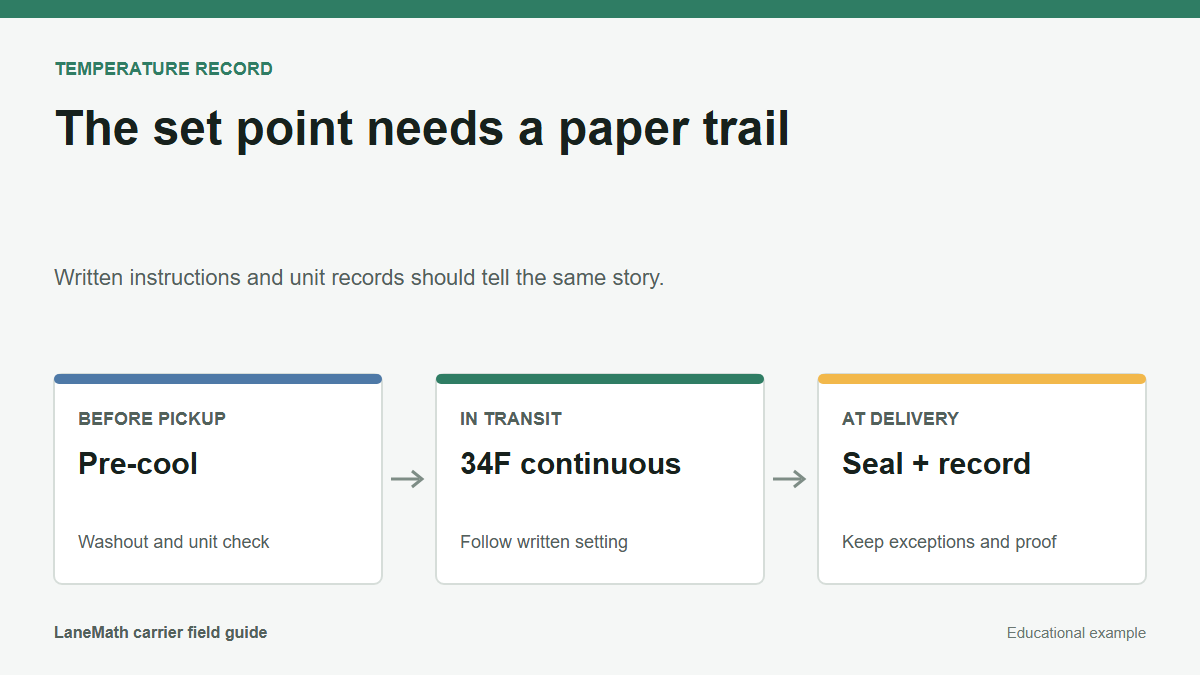
Reefer service checkpoints
The rate should reflect temperature service, equipment preparation, fuel, and the records required if instructions change.
| Signal | Why it matters | Next check |
|---|---|---|
| Set point is provided | Cycle mode, continuous run, and pre-cool may still be unspecified. | Confirm the full operating instruction in writing. |
| Washout is required | Trailer readiness adds time and direct cost before pickup. | Confirm acceptable washout proof and whether cost is included. |
| Shipper changes temperature | The driver may hold conflicting instructions. | Obtain a written revision before leaving. |
| Receiver questions product condition | Seal, temperature, and communication records become important. | Preserve unit data and follow the claim-notification process. |
Key takeaways
- Confirm temperature range, continuous run, washout, pulp checks, and reefer fuel handling.
- Watch strict appointment windows and rejection risk.
- Keep temperature and seal records according to load instructions.
Working frame for reefer rate basics
A dispatch guide to temperature-controlled load factors carriers should price into decisions, focused on equipment requirements, facility details, accessorial exposure, and usable written instructions. The first operating question is whether the subject changes money, time, equipment fit, payment exposure, or the truck's position after delivery. Keep those effects separate so one attractive number does not hide an unresolved condition.
Checks before the truck is committed
Confirm temperature range, continuous run, washout, pulp checks, and reefer fuel handling. Watch strict appointment windows and rejection risk. Keep temperature and seal records according to load instructions. Write down any term that still depends on a broker reply before dispatch. Confirm the exact commodity, weight, equipment, appointments, facility rules, and approval path that apply to this load rather than relying on a familiar lane or broker relationship.
Operating note
Reefer freight adds temperature and product-integrity questions to the normal rate review. Confirm set point, continuous run, pre-cool, washout, pulp checks, seal rules, and rejection procedures. The carrier should also ask how reefer fuel and delay time are handled if the unit must run longer because of facility dwell. A strong reefer load is not only a higher gross number; it is a load with clear instructions and usable records.
Which temperature instructions control the load?
Confirm set point, continuous or cycle mode, pre-cool requirement, product temperature checks, washout, seal procedure, fuel responsibility, and rejection instructions. Ask who must be contacted if the shipper's instruction conflicts with the confirmation or reefer unit settings.
A set point is only one part of reefer service
Carriers can focus on the temperature number and overlook pre-cooling, pulp checks, airflow, trailer cleanliness, and continuous-run fuel. Another risk is accepting verbal temperature changes without a written revision, leaving the driver with competing instructions if a claim arises.
Preserve the temperature trail
Keep written settings, pre-trip and washout records, reefer fuel notes, seal numbers, temperature downloads or checks when required, BOL instructions, and communications about exceptions. The final file should show what the carrier was instructed to do and what the unit actually did.
Example scenario
The confirmation states 34 degrees continuous, but the shipper asks the driver to run 36 degrees on cycle mode. The carrier should pause for written clarification. A higher rate does not compensate for carrying conflicting temperature instructions. The numbers and circumstances are educational examples; replace them with the actual route, written terms, costs, and operating limits for the load being considered.
What to check before booking
- Confirm temperature range, continuous run, washout, pulp checks, and reefer fuel handling.
- Watch strict appointment windows and rejection risk.
- Keep temperature and seal records according to load instructions.
- Write down any term that still depends on a broker reply before dispatch.
Common questions
What extra checks does reefer freight require before booking?
Confirm temperature set point, continuous-run or cycle-sentry setting, pre-cool requirement, pulp check procedures if applicable, washout or prior-load compatibility, and what the receiver's rejection process looks like. Also confirm how reefer fuel is handled if facility dwell extends the unit run.
Does reefer freight always pay more than dry van?
Not always. Reefer typically commands a premium because of equipment cost, temperature compliance risk, and appointment sensitivity. However, a poorly documented reefer load with a strict receiver that rejects on temperature can turn a higher gross into a net loss. Rate comparison should include compliance risk, not just posted gross.
What is a continuous-run setting versus a cycle-sentry setting, and why does it matter before booking?
Continuous run keeps the reefer unit running at all times regardless of temperature stability. Cycle sentry cycles the unit on and off as the trailer temperature holds within range. Some commodities — produce, certain pharmaceuticals — require continuous run per shipper specification. Using the wrong setting can result in a rejected load even when the temperature stayed within range during transit. The rate confirmation or shipper instructions should specify the required setting.
How should a reefer carrier document temperature during a load?
Most reefer units generate a continuous temperature download that records unit operation, temperature readings, and any alarm events. Pulling that download after delivery and keeping it with the BOL, POD, and rate confirmation creates a defensible record if the receiver claims a temperature issue. Some shippers require the download before or at delivery. Confirming what is required before pickup prevents a paperwork gap at the receiver.
References and methodology
- Operational Costs of Trucking - American Transportation Research Institute. Used here for: Per-mile carrier operational cost context for educational rate, fuel, and profitability examples.Annual industry report used for general cost-structure background. Not a source for lane-specific rates or broker pricing. Last checked 2026-06-29.
- Gasoline and Diesel Fuel Update - U.S. Energy Information Administration. Used here for: Diesel price context for educational fuel surcharge examples.LaneMath tools do not pull live EIA data. Last checked 2026-06-29.
- Industry terminology and editorial explanation - LaneMath Editorial Desk. Used here for: Plain-English definitions, checklists, and example-only calculations.Editorial explanations are not official guidance, legal advice, or market data. Last checked 2026-06-29.