How to protect yourself from unpaid accessorials
A paperwork-first guide to reducing accessorial billing disputes by checking approval language and records before dispatch and during delays, including the written terms and records that matter before dispatch and after delivery.
Written and reviewed by LaneMath Editorial Team, with carrier workflow review from Dale Morrow where practical dispatch, paperwork, or lane-planning context is involved. Updated 2026-06-29. LaneMath pages use public references, example-only math, and conservative editorial review.
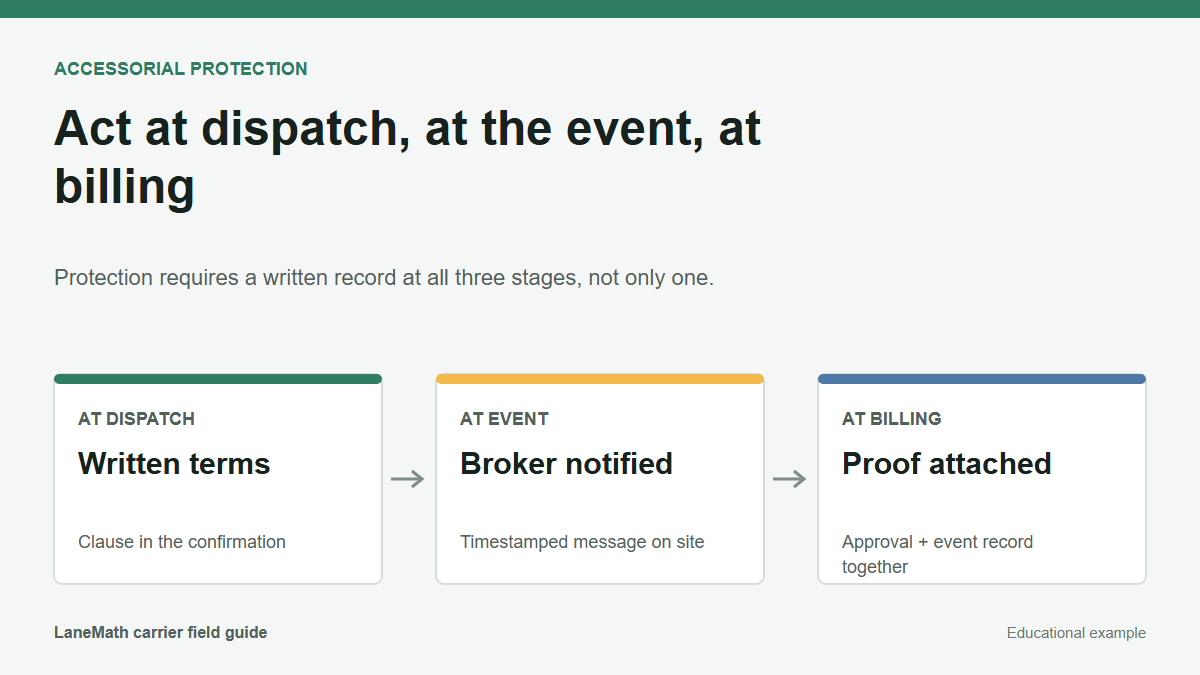
Accessorial protection table
Protecting accessorial billing requires action at dispatch, at the event, and during invoicing — not only after the load delivers.
| Signal | Why it matters | Next check |
|---|---|---|
| Confirmation is silent on the charge type | A missing clause creates a dispute-by-default situation at billing. | Ask for written terms before the truck is dispatched. |
| Event is about to happen at the facility | Real-time documentation is stronger than after-the-fact reconstruction. | Send a message to the broker while the truck is still on site. |
| Broker says to bill it after delivery | An oral instruction at the dock creates a weaker record than a written approval. | Send a confirmation message referencing the broker's instruction before leaving. |
| Invoice is disputed at payment | An undocumented accessorial has no anchor point in the load file. | Compare the billing file against the confirmation and all approval messages. |
Key takeaways
- Read accessorial clauses before the truck reaches the facility.
- Ask for approval before incurring avoidable out-of-pocket costs.
- Keep timestamps, receipts, POD, BOL, and written approvals in one file.
Working frame for how to protect yourself from unpaid accessorials
A paperwork-first guide to reducing accessorial billing disputes by checking approval language and records before dispatch and during delays, including the written terms and records that matter before dispatch and after delivery. The first operating question is whether the subject changes money, time, equipment fit, payment exposure, or the truck's position after delivery. Keep those effects separate so one attractive number does not hide an unresolved condition.
Checks before the truck is committed
Read accessorial clauses before the truck reaches the facility. Ask for approval before incurring avoidable out-of-pocket costs. Keep timestamps, receipts, POD, BOL, and written approvals in one file. Write down any term that still depends on a broker reply before dispatch. Confirm the exact commodity, weight, equipment, appointments, facility rules, and approval path that apply to this load rather than relying on a familiar lane or broker relationship.
Operating note
Unpaid accessorial risk usually starts when approval is assumed instead of documented. A carrier can reduce that risk by checking the confirmation before the event, sending delay or cost notices while the truck is still on site, and asking whether the broker wants a revised confirmation, email approval, or invoice note. The strongest accessorial file connects the charge to a specific load event: timestamp, receipt, facility instruction, broker approval, POD, BOL, and invoice. The goal is a complete record, not a louder argument after billing.
What must happen before the charge is incurred?
Review prior-approval language, notice deadlines, free time, rate caps, receipts, timestamps, and who can authorize the charge. Ask how the broker wants a delay or out-of-pocket cost reported while the truck is still on site. Each accessorial can have a different proof requirement.
Proof of cost may not prove approval
A lumper receipt shows that money was paid; it may not show that the broker agreed to reimburse it. Timestamps can establish detention but still miss a notice deadline. Carriers lose leverage when they gather evidence only after the event and never connect it to the written approval process.
Build one packet for each charge
Keep the governing confirmation clause, event notice, approval, amount, receipt or time record, BOL or POD notation, revised confirmation, and invoice line. If approval is denied, preserve that response as well. One complete packet is easier to follow than a mixed folder of every accessorial on the load.
Example scenario
The receiver orders a driver unload not shown on the confirmation. Before starting, the carrier sends the facility instruction and requested amount to the broker. The written response either creates an approval record or gives the carrier a basis to decline work outside the agreement. The numbers and circumstances are educational examples; replace them with the actual route, written terms, costs, and operating limits for the load being considered.
What to check before booking
- Read accessorial clauses before the truck reaches the facility.
- Ask for approval before incurring avoidable out-of-pocket costs.
- Keep timestamps, receipts, POD, BOL, and written approvals in one file.
- Write down any term that still depends on a broker reply before dispatch.
Common questions
What is the most common reason accessorial charges go unpaid?
Missing or incomplete documentation. Detention without timestamps, lumper charges without receipts, layover without written approval, and verbal TONU confirmations that were never put in writing all create gaps that make billing disputes harder to resolve.
Can a carrier recover an accessorial charge after the invoice is paid?
It becomes significantly harder once the invoice is closed. Accessorial billing is generally tied to the invoice cycle. If an approved charge was omitted from the original invoice, the carrier should address it promptly rather than waiting for the next billing run.
Which accessorial charges are most often disputed and how can carriers protect against that?
Detention and lumper reimbursement are the most commonly disputed charges. Detention disputes typically come from missing or conflicting timestamps. Lumper disputes often stem from a receipt that lacks a load reference or was paid without prior approval. Both are easier to protect against by confirming terms before the event and sending the documentation to the broker while still on site.
Is it possible to include a clause in the carrier's own paperwork requiring accessorial payment?
Carriers can include standard terms in their carrier packet or onboarding documents that reference accessorial policies, but the enforceable terms for a specific load are those in the signed rate confirmation. A general carrier policy statement is useful background but it does not override specific confirmation terms. Getting accessorial approval for the actual load in the actual confirmation is more reliable than relying on general carrier terms.
References and methodology
- Accessorial documentation editorial methodology - LaneMath Editorial Desk. Used here for: Detention, lumper, layover, TONU, revised confirmation, and post-delivery document workflow examples.Used for documentation workflows and example scenarios, not for legal claims about collectability. Last checked 2026-06-29.