How to plan a load before calling the broker
A practical risk review for pre-call planning for location, hours, route, accessorial risk, broker questions, and reload direction, written for carriers that need cleaner broker checks and billing records before committing a truck.
Written and reviewed by LaneMath Editorial Team, with carrier workflow review from Dale Morrow where practical dispatch, paperwork, or lane-planning context is involved. Updated 2026-06-29. LaneMath pages use public references, example-only math, and conservative editorial review.
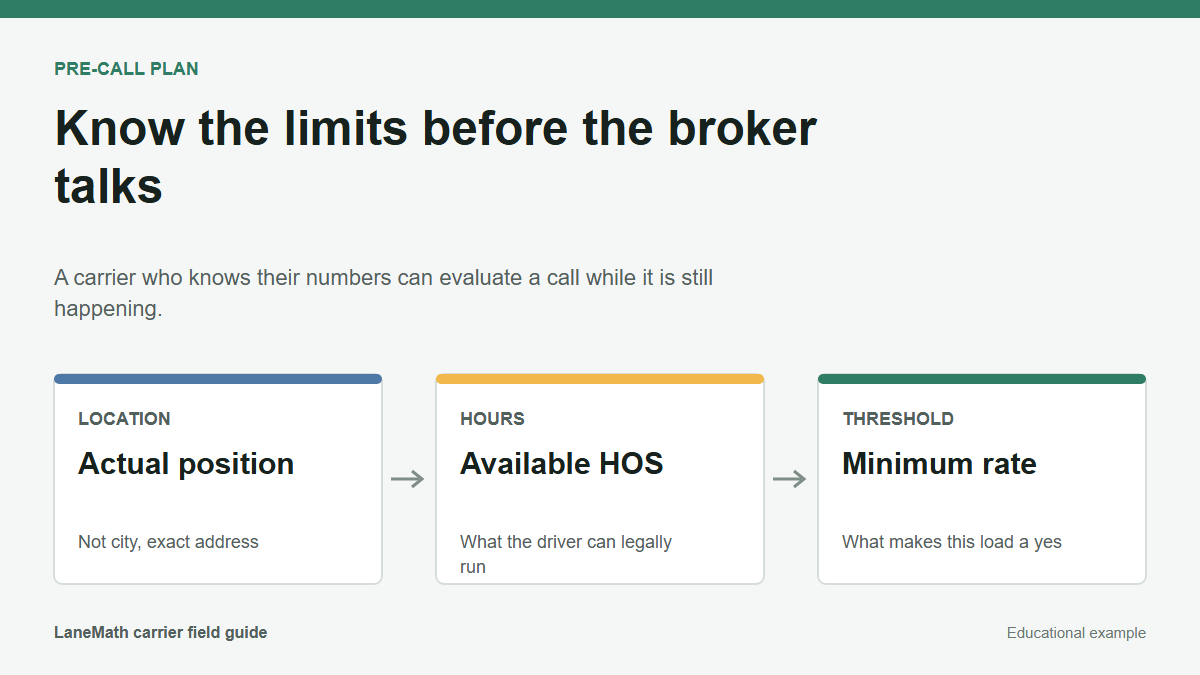
Pre-call planning table
Planning before the call converts the broker conversation from a discovery exercise into a decision exercise.
| Signal | Why it matters | Next check |
|---|---|---|
| Truck position is not confirmed | Approach miles from the wrong starting point produce a wrong total-mile estimate. | Confirm actual truck location before evaluating deadhead to pickup. |
| Hours are not checked | A load that requires pickup in four hours may not be achievable given available drive time. | Verify available hours before calling so the timeline check happens before commitment. |
| Known concern is not written down | A verbal concern raised on the call can be talked past by a confident broker. | Write the specific condition that would make the load a no before dialing. |
| Trip cost estimate is missing | A rate that looks strong without a cost estimate may not look as strong with one. | Estimate fuel, tolls, and any expected accessorial costs before the call starts. |
Key takeaways
- Check truck location, deadhead, hours, equipment, and fuel plan first.
- Write the questions that must be answered before booking.
- Know what change would make the load no longer fit.
Working frame for how to plan a load before calling the broker
A practical risk review for pre-call planning for location, hours, route, accessorial risk, broker questions, and reload direction, written for carriers that need cleaner broker checks and billing records before committing a truck. The first operating question is whether the subject changes money, time, equipment fit, payment exposure, or the truck's position after delivery. Keep those effects separate so one attractive number does not hide an unresolved condition.
Checks before the truck is committed
Check truck location, deadhead, hours, equipment, and fuel plan first. Write the questions that must be answered before booking. Know what change would make the load no longer fit. Write down any term that still depends on a broker reply before dispatch. Confirm the exact commodity, weight, equipment, appointments, facility rules, and approval path that apply to this load rather than relying on a familiar lane or broker relationship.
Operating note
Pre-call planning turns a reactive booking call into a structured decision. A carrier who knows truck location, available hours, fuel situation, appointment pressure, and home-time constraints before calling can evaluate each load claim as the broker makes it. Without that preparation, the carrier tests each variable in real time while the broker waits. Pre-call planning matters most on unfamiliar brokers or lanes, where there is no established pattern to fall back on.
Know your no before the call
Before calling, write the condition that would make the load a no. It may be a late appointment, too much deadhead, weak accessorial language, poor reload position, or broker payment uncertainty. Knowing that line keeps the call focused and makes it easier to walk away cleanly.
What must the broker answer for this truck?
Calculate approach miles, earliest legal arrival, equipment fit, likely route, fuel need, and destination plan before dialing. Write the unknowns that could change the decision. The broker call should test a prepared plan rather than build the entire plan while the offer is waiting.
Negotiating before locating the truck
A dispatcher may secure a better rate and then discover the pickup is across the metro from the truck or the driver lacks hours. Another mistake is asking routine questions without knowing which answer would make the load unacceptable, allowing urgency to move the decision line.
Keep a short pre-call calculation
Note truck position, available hours, empty miles, route, fuel or toll concern, required appointment, target rate, and walk-away condition. Add confirmed answers after the call. The before-and-after view shows whether the final load still resembles the opportunity that was planned.
Example scenario
A posting looks close to the truck, but the exact pickup could fall on either side of a large metro. Dispatch estimates both outcomes and decides that more than 70 approach miles would make the appointment too tight. That becomes the first broker question. The numbers and circumstances are educational examples; replace them with the actual route, written terms, costs, and operating limits for the load being considered.
What to check before booking
- Check truck location, deadhead, hours, equipment, and fuel plan first.
- Write the questions that must be answered before booking.
- Know what change would make the load no longer fit.
- Write down any term that still depends on a broker reply before dispatch.
Common questions
What should a carrier know before calling a broker about a posted load?
Before calling, know the truck's current location, available hours, fuel range, equipment type, and any home-time or cash-flow constraints. That information lets the carrier quickly assess whether the load fits without needing to put the broker on hold. It also surfaces potential problems before the rate discussion starts.
Is pre-call planning worth the time for every load?
For routine loads on familiar lanes with known brokers, a lighter review may be sufficient. For unfamiliar brokers, unusual lanes, complex equipment requirements, or loads with accessorial exposure, a short written pre-call review — even two or three key questions — typically surfaces issues that would otherwise appear after the truck is already moving.
What is a practical pre-call checklist that takes under three minutes?
Write the truck's current location, estimated deadhead to the pickup city, available hours for the pickup day and delivery day, and one known concern — weak reload market, cash flow constraint, equipment fit question. That short list keeps the broker call from starting blind. If any item on the list would make the load a no, the call can be skipped or redirected quickly.
How does pre-call planning affect the rate discussion with a broker?
A carrier who knows their total miles, approach deadhead, and trip cost before calling can engage on rate more specifically. Instead of responding to the broker's number with a vague counter, the carrier can say the truck is 55 empty miles out and the approach changes the all-in economics. That kind of specific context gives the broker something to respond to rather than a general request for more.
References and methodology
- Load comparison example methodology - LaneMath Editorial Desk. Used here for: Example-only load comparison, weekly freight planning, reload uncertainty, and equipment-specific economics.Used for static planning examples based on carrier-entered assumptions, not pricing feeds or market forecasts. Last checked 2026-06-29.