How to avoid getting trapped in a weak lane
A carrier-oriented look at recognizing when a delivery market may create extra empty miles, poor timing, or limited practical reload choices, with attention to empty miles, appointment pressure, cost exposure, and the next move after delivery.
Written and reviewed by LaneMath Editorial Team, with carrier workflow review from Dale Morrow where practical dispatch, paperwork, or lane-planning context is involved. Updated 2026-06-29. LaneMath pages use public references, example-only math, and conservative editorial review.
Weak-lane risk table
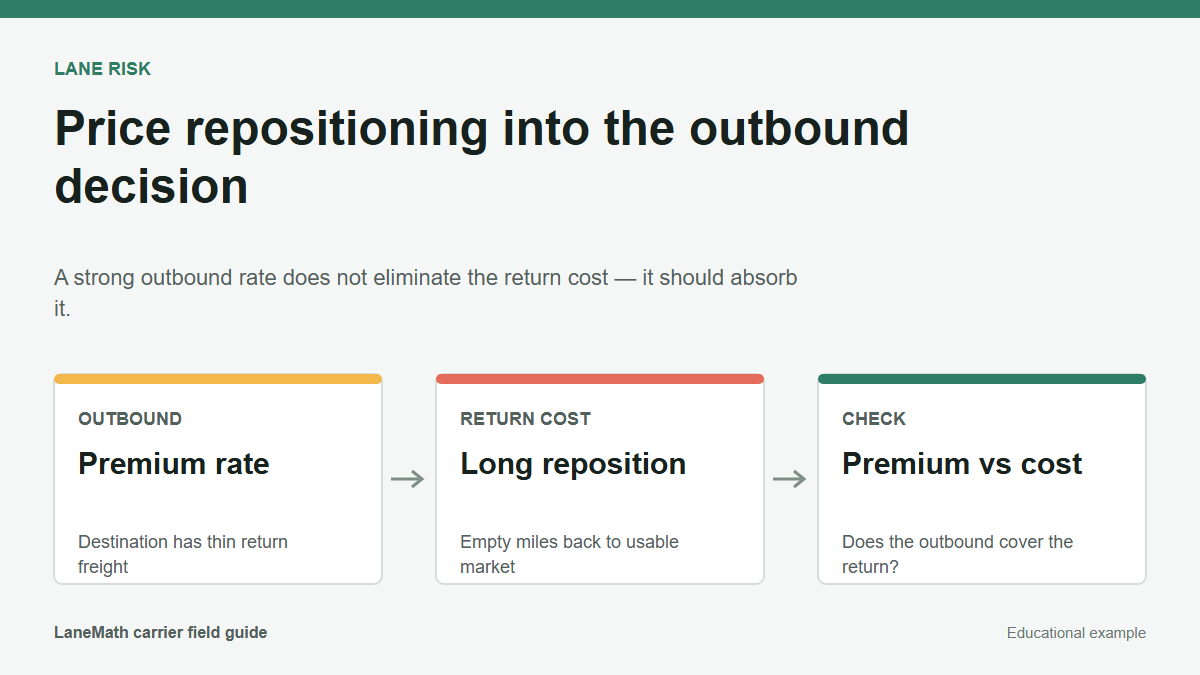
The outbound rate does not eliminate repositioning cost — it should be large enough to include it.
| Signal | Why it matters | Next check |
|---|---|---|
| Delivery market posts thin for the equipment | A destination with few compatible loads creates a repositioning cost regardless of the outbound rate. | Estimate the repositioning cost and add it to the trip when evaluating the outbound. |
| Outbound rate looks strong compared to the market | A premium rate may exist because other carriers know the return is weak. | Check whether the premium covers the expected repositioning before accepting. |
| Friday delivery to a thin secondary market | Weekend freight is often thinner, compounding a market that is already slow. | Price a weekend repositioning into the decision before accepting the outbound. |
| Carrier has been to this market before | Historical experience with a market is more useful than current board count. | Use prior experience as the primary estimate source when available. |
Key takeaways
- Check reload options before accepting the outbound load.
- Price the first load with the likely repositioning move in mind.
- Ask whether delivery timing blocks same-day reload choices.
Working frame for how to avoid getting trapped in a weak lane
A carrier-oriented look at recognizing when a delivery market may create extra empty miles, poor timing, or limited practical reload choices, with attention to empty miles, appointment pressure, cost exposure, and the next move after delivery. The first operating question is whether the subject changes money, time, equipment fit, payment exposure, or the truck's position after delivery. Keep those effects separate so one attractive number does not hide an unresolved condition.
Checks before the truck is committed
Check reload options before accepting the outbound load. Price the first load with the likely repositioning move in mind. Ask whether delivery timing blocks same-day reload choices. Write down any term that still depends on a broker reply before dispatch. Confirm the exact commodity, weight, equipment, appointments, facility rules, and approval path that apply to this load rather than relying on a familiar lane or broker relationship.
Operating note
A weak lane usually reveals itself in the backhaul, not the headhaul. The outbound load delivers well; the return side has thin volume, low rates, or a long deadhead to the nearest usable freight. A dispatcher who books the outbound without checking whether the backhaul market supports the truck's equipment is pricing only half the lane. The practical check is whether the gross revenue from the outbound covers both the trip cost and a realistic repositioning move — if it does not, the spot market at the delivery end needs to be stronger than average to make the trip work. Dwell time at the delivery facility can compound the problem: a truck that waits three hours at a receiver in a thin market has burned time that a clean drop-and-hook in a stronger lane would have returned as usable drive hours.
What trapped looks like in practice
A weak lane is not always obvious at pickup. It often shows up after delivery, when the truck has hours left but the practical freight is too far away, too low for the equipment, or too late to protect the next day. The warning sign is not only a low rate. It is a delivery plan that leaves the truck with bad options.
What is the exit plan before the truck enters?
Look at usable reload areas, pickup timing after delivery, empty distance, equipment demand, home direction, and a fallback if freight is weak. Ask whether the outbound offer pays enough to cover a realistic repositioning move rather than assuming the destination city itself is the reload market.
A strong outbound rate can fund the trap
The first load may pay enough to silence concerns about the destination, but a long empty move or two idle days can erase the advantage. Another error is accepting a cheap reload only because it exits the market, creating a second weak delivery position.
Keep the planned exit with the booking note
Record destination freight areas, expected reload radius, time available, fallback direction, and repositioning estimate. After the trip, note actual wait and empty miles. Repeated lane notes reveal destinations that consistently require more exit cost than the outbound quote assumes.
Example scenario
A premium load delivers Friday afternoon into a market where the carrier's equipment rarely reloads until Monday. The apparent premium must be compared with weekend parking, idle time, or the miles needed to reach another market before calling the lane strong. The numbers and circumstances are educational examples; replace them with the actual route, written terms, costs, and operating limits for the load being considered.
What to check before booking
- Check reload options before accepting the outbound load.
- Price the first load with the likely repositioning move in mind.
- Ask whether delivery timing blocks same-day reload choices.
- Write down any term that still depends on a broker reply before dispatch.
Common questions
What makes a delivery market a trap for a carrier?
A market becomes a trap when reload options are limited for the carrier's equipment, return rates are low, and the truck has to reposition far to find the next practical load. The problem is not only the outbound rate — it is that accepting the load commits the truck to dealing with that delivery market regardless of what develops.
How can a carrier check whether a delivery market is weak before accepting?
A scan of load board volume and rates for the carrier's equipment type in the delivery city gives a rough read. Asking dispatchers or other carriers with experience in that market adds more texture. The practical test: if the outbound load paid nothing, would the carrier still want to be in that delivery city with this equipment on this day?
Is it possible to get trapped even in a city with high load board volume?
Yes. High volume does not automatically mean good rates or equipment compatibility. A market flooded with dry van loads does not help a reefer carrier. A market with good volume for the equipment type but consistently low rates traps the truck in a different way — there is freight available, but accepting it at the prevailing rate still produces poor economics. Volume and rate quality are separate checks.
How much extra pay makes a trap-risk lane worth taking?
There is no universal answer. The useful calculation compares the outbound gross against the likely cost of repositioning from the delivery market to the next productive area. If the outbound rate exceeds standard pay for a comparable trip plus the estimated repositioning cost, the premium may make the risk acceptable. If the rate only looks strong because repositioning costs are being ignored, the math usually does not hold up on review.
References and methodology
- Lane planning methodology - LaneMath Editorial Desk. Used here for: Example-only lane economics, deadhead questions, accessorial checks, and planning prompts.Methodology source for practical examples. It is not freight pricing data, load board data, or a broker quote source. Last checked 2026-06-29.
- Load comparison example methodology - LaneMath Editorial Desk. Used here for: Example-only load comparison, weekly freight planning, reload uncertainty, and equipment-specific economics.Used for static planning examples based on carrier-entered assumptions, not pricing feeds or market forecasts. Last checked 2026-06-29.