How dispatchers compare loads
A load-selection guide to how dispatchers can compare gross revenue, total miles, timing, broker quality, and next-load options, built around what to ask, what to verify, and what to write down before the truck moves.
Written and reviewed by LaneMath Editorial Team, with carrier workflow review from Dale Morrow where practical dispatch, paperwork, or lane-planning context is involved. Updated 2026-06-29. LaneMath pages use public references, example-only math, and conservative editorial review.
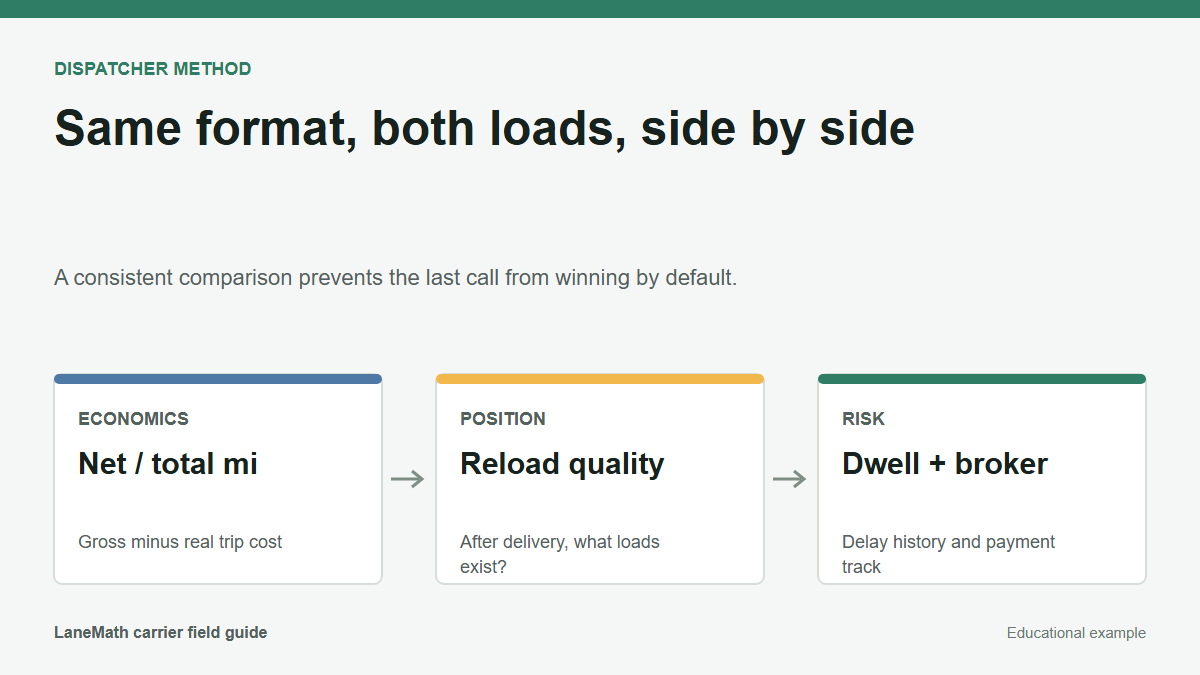
Dispatcher comparison framework table
Dispatchers comparing loads across a fleet should use a consistent format that separates economics from position from risk.
| Signal | Why it matters | Next check |
|---|---|---|
| One load has higher gross | Higher gross may come with higher dwell, weaker reload, or more billing complexity. | Check gross per total mile and reload quality before choosing on gross alone. |
| Appointment timing creates a fleet conflict | One truck's load choice may affect another truck's pickup access or hours. | Evaluate the full fleet schedule before committing a truck to a close call. |
| Broker relationship differs | A familiar, reliable broker may be worth a slightly lower gross. | Consider payment track record and billing consistency in the comparison. |
| Loads are close on all visible metrics | Tie-breakers often sit in non-rate factors. | Compare reload position, appointment risk, and broker payment terms as the final filter. |
Key takeaways
- Normalize each load by total miles, not only posted loaded miles.
- Mark appointment risk, receiver delay risk, and reload fit.
- Keep notes short enough to use during a broker call.
Working frame for how dispatchers compare loads
A load-selection guide to how dispatchers can compare gross revenue, total miles, timing, broker quality, and next-load options, built around what to ask, what to verify, and what to write down before the truck moves. The first operating question is whether the subject changes money, time, equipment fit, payment exposure, or the truck's position after delivery. Keep those effects separate so one attractive number does not hide an unresolved condition.
Checks before the truck is committed
Normalize each load by total miles, not only posted loaded miles. Mark appointment risk, receiver delay risk, and reload fit. Keep notes short enough to use during a broker call. Write down any term that still depends on a broker reply before dispatch. Confirm the exact commodity, weight, equipment, appointments, facility rules, and approval path that apply to this load rather than relying on a familiar lane or broker relationship.
Operating note
A dispatcher's comparison problem differs from an owner-operator's. An owner-operator decides for one truck; a dispatcher may be deciding across a fleet where loads interact. A load that looks weak for one truck may position another truck favorably for the next day. The same Atlanta delivery that strands a solo driver might let a fleet dispatcher cover a Charlotte reload with a second unit. Dispatchers who compare loads only on gross and miles tend to miss those fleet-level trade-offs. The more useful comparison captures appointment timing, reload fit for each truck's position, broker relationship quality, and whether the back half of the trip creates another usable load or a positioning cost.
Which truck makes each offer usable?
Compare each load against the specific unit's location, hours, trailer, driver constraints, current customer commitments, and next position. In a small fleet, also ask whether assigning one truck blocks a better combination for another. Fleet value can differ from single-load value.
A board ranking is not a dispatch plan
Sorting by gross or rate per mile ignores truck-to-load fit. Dispatchers can also optimize one assignment while leaving another truck stranded or sending both units toward the same weak market. The better fleet result may use the second-best individual rate.
Keep the assignment reason visible
Record candidate loads, assigned unit, total miles, appointment fit, main risk, and expected next position. After the day closes, compare actual outcomes. A short assignment log helps separate a poor load choice from an operating event that could not reasonably be known.
Example scenario
A Dallas load pays best for either truck. The closer truck lacks enough hours for the receiver window, while the farther truck can complete it and finish near a customer pickup. Assigning by distance alone would miss both schedule and fleet positioning. The numbers and circumstances are educational examples; replace them with the actual route, written terms, costs, and operating limits for the load being considered.
What to check before booking
- Normalize each load by total miles, not only posted loaded miles.
- Mark appointment risk, receiver delay risk, and reload fit.
- Keep notes short enough to use during a broker call.
- Write down any term that still depends on a broker reply before dispatch.
Common questions
What is the most useful format for comparing two loads side by side?
A short written table works better than a mental comparison: one row per load, columns for gross, loaded miles, estimated empty miles, total miles, appointment time, dwell risk, reload position, and payment terms. That format forces both loads through the same questions and makes trade-offs visible rather than depending on which load was presented most recently or confidently.
How should a dispatcher handle a broker who pressures for an immediate decision?
A dispatcher can commit to a response time and hold to it. Saying 'I need five minutes to check mileage and hours' is a normal business step, not an insult. Pressure before that review is complete is worth noting — a broker who cannot wait for a standard load review may create other timeline problems during execution.
How does dispatching for a fleet change load comparison versus single-truck decisions?
Fleet dispatchers compare loads across multiple trucks and future days simultaneously. A load that is marginal for one truck may be the best option to position another truck for a strong next move. Dispatchers also weigh broker relationships across multiple loads — a slightly weaker rate from a reliable broker may be worth more than a slightly stronger rate from a broker with slow payment history across the fleet.
What is the biggest dispatch mistake when loads look approximately equal?
Choosing based on which broker called most recently or which load was described most confidently, rather than running both through the same comparison framework. Loads that feel close often have a clear answer when the non-rate factors — dwell risk, reload position, appointment reliability — are written side by side. The comparison format produces better decisions than relying on which load was presented first.
References and methodology
- Load comparison example methodology - LaneMath Editorial Desk. Used here for: Example-only load comparison, weekly freight planning, reload uncertainty, and equipment-specific economics.Used for static planning examples based on carrier-entered assumptions, not pricing feeds or market forecasts. Last checked 2026-06-29.