How brokers price loads
A practical risk review for common inputs brokers consider when quoting or covering a truckload, written for carriers that need cleaner broker checks and billing records before committing a truck.
Written and reviewed by LaneMath Editorial Team, with carrier workflow review from Dale Morrow where practical dispatch, paperwork, or lane-planning context is involved. Updated 2026-06-29. LaneMath pages use public references, example-only math, and conservative editorial review.
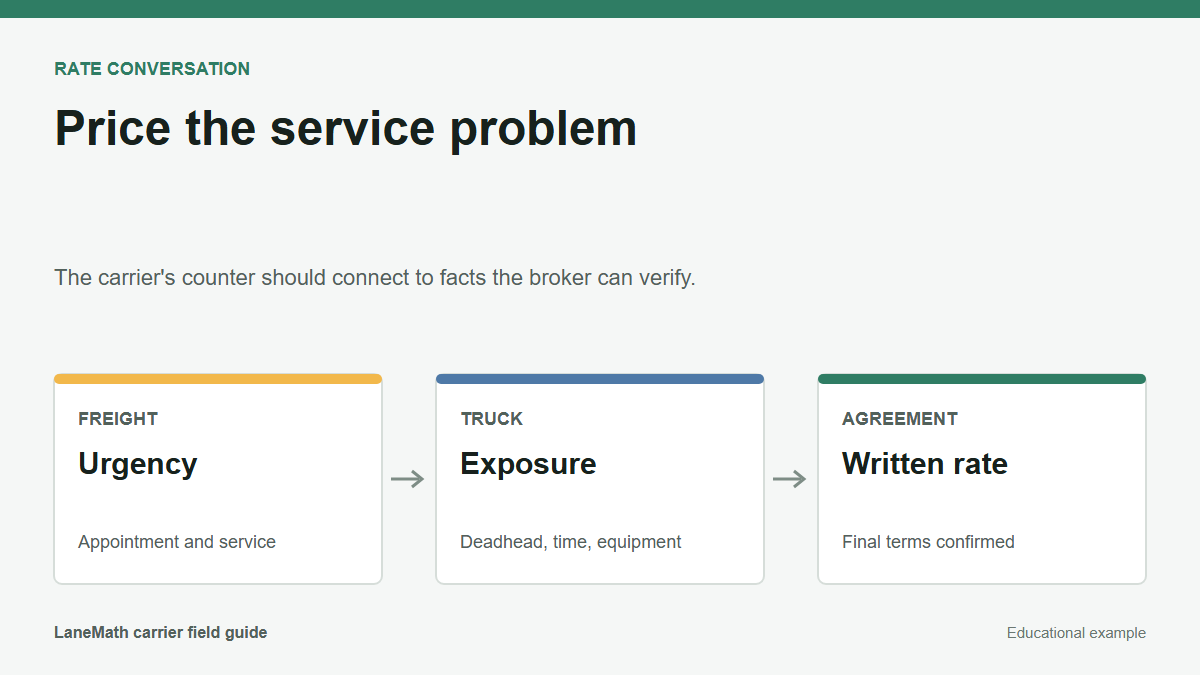
Broker-offer signals
The carrier does not need to know the broker's margin to identify the service facts affecting its own quote.
| Signal | Why it matters | Next check |
|---|---|---|
| Pickup is urgent | The broker may be solving a coverage or appointment problem. | Confirm the actual cutoff and whether it is achievable. |
| Equipment is restrictive | Fewer suitable trucks may be available, while the carrier faces extra service work. | Name the equipment requirement in the counteroffer. |
| Destination is difficult | The truck may need more empty miles or wait for a reload. | Explain the delivery-side exposure rather than citing a vague market. |
| Offer increases quickly | Urgency may be rising, but other terms can still be incomplete. | Recheck appointments and confirmation language before accepting. |
Key takeaways
- Ask what is firm, what is appointment-sensitive, and what is included.
- Separate broker margin questions from your own operating cost decision.
- Verify any verbal changes on an updated confirmation.
Working frame for how brokers price loads
A practical risk review for common inputs brokers consider when quoting or covering a truckload, written for carriers that need cleaner broker checks and billing records before committing a truck. The first operating question is whether the subject changes money, time, equipment fit, payment exposure, or the truck's position after delivery. Keep those effects separate so one attractive number does not hide an unresolved condition.
Checks before the truck is committed
Ask what is firm, what is appointment-sensitive, and what is included. Separate broker margin questions from your own operating cost decision. Verify any verbal changes on an updated confirmation. Write down any term that still depends on a broker reply before dispatch. Confirm the exact commodity, weight, equipment, appointments, facility rules, and approval path that apply to this load rather than relying on a familiar lane or broker relationship.
Operating note
Broker pricing is not the same as carrier profitability. A broker may be balancing shipper budget, service urgency, lane history, available trucks, appointment pressure, and customer commitments. The carrier still has to price from its own cost structure and risk tolerance. A useful negotiation separates those views: the broker explains the freight requirement, and the carrier explains the truck cost, timing exposure, and terms needed to move it responsibly.
What service problem is the broker solving?
Ask whether the load is urgent, appointment-sensitive, difficult to cover, or tied to special equipment. Clarify what the shipper requires and what is already fixed. The broker may not disclose its customer rate or margin, but the service facts still help the carrier decide what the truck must be paid.
Broker margin is not the carrier's cost model
A carrier can spend the entire call arguing about what the broker might earn and never explain its own deadhead, time, equipment, or destination problem. The opposite mistake is accepting the broker's lane history as proof that the load works for this truck. Both sides price from different constraints.
Keep the facts behind the quote
Note the offer, counteroffer, pickup urgency, appointment type, commodity, weight, equipment, and any accessorial language discussed. Save the final confirmation. Those details explain why a rate changed more reliably than a note that simply says the broker came up.
Example scenario
A same-day pickup has sat uncovered while the appointment clock approaches. The carrier has 95 miles of deadhead and must cross a congested metro before check-in. Rather than guessing at broker margin, the carrier can price the empty miles and schedule pressure and ask for a specific written increase. The numbers and circumstances are educational examples; replace them with the actual route, written terms, costs, and operating limits for the load being considered.
What to check before booking
- Ask what is firm, what is appointment-sensitive, and what is included.
- Separate broker margin questions from your own operating cost decision.
- Verify any verbal changes on an updated confirmation.
- Write down any term that still depends on a broker reply before dispatch.
Common questions
Does a broker share how they priced a load?
Brokers are generally not required to disclose their margin. What matters for the carrier is whether the offered rate covers the carrier's actual operating costs and fits the carrier's business criteria. How the broker arrived at the number is a separate question from whether the load makes sense for that truck.
Can carriers use an understanding of broker pricing to negotiate better?
Understanding what factors affect broker quotes — market conditions, time sensitivity, equipment scarcity, appointment risk — helps carriers frame conversations more effectively. A carrier who can articulate total-mile cost, timing, and reload plan typically has a more productive rate discussion than one who argues based on assumptions about broker margin.
Do brokers pay different rates to different carriers for the same load?
Yes. Brokers may offer different rates based on equipment availability, carrier capacity, relationship history, service track record, and timing. A carrier who accepts quickly at a low opening offer may receive less than one who counters with specific service information. The posted or first-offered rate is often not the only rate the broker is willing to pay.
What makes a broker willing to increase their offer from the opening number?
Specific service information usually moves the conversation more than a general request for more money. Equipment scarcity for the load type, approach deadhead, tight appointment timing, difficult receiver, or strong reload demand in the opposite direction all give the broker a concrete reason to adjust. Abstract negotiation without load-specific context rarely produces a meaningful result.
References and methodology
- Broker Registration - Federal Motor Carrier Safety Administration. Used here for: Broker authority and registration background.Used as a public reference for broker basics. Last checked 2026-06-29.
- Industry terminology and editorial explanation - LaneMath Editorial Desk. Used here for: Plain-English definitions, checklists, and example-only calculations.Editorial explanations are not official guidance, legal advice, or market data. Last checked 2026-06-29.