Flatbed rate basics
A dispatch guide to open-deck details that can change time, labor, and risk, focused on equipment requirements, facility details, accessorial exposure, and usable written instructions.
Written and reviewed by LaneMath Editorial Team, with carrier workflow review from Dale Morrow where practical dispatch, paperwork, or lane-planning context is involved. Updated 2026-06-29. LaneMath pages use public references, example-only math, and conservative editorial review.
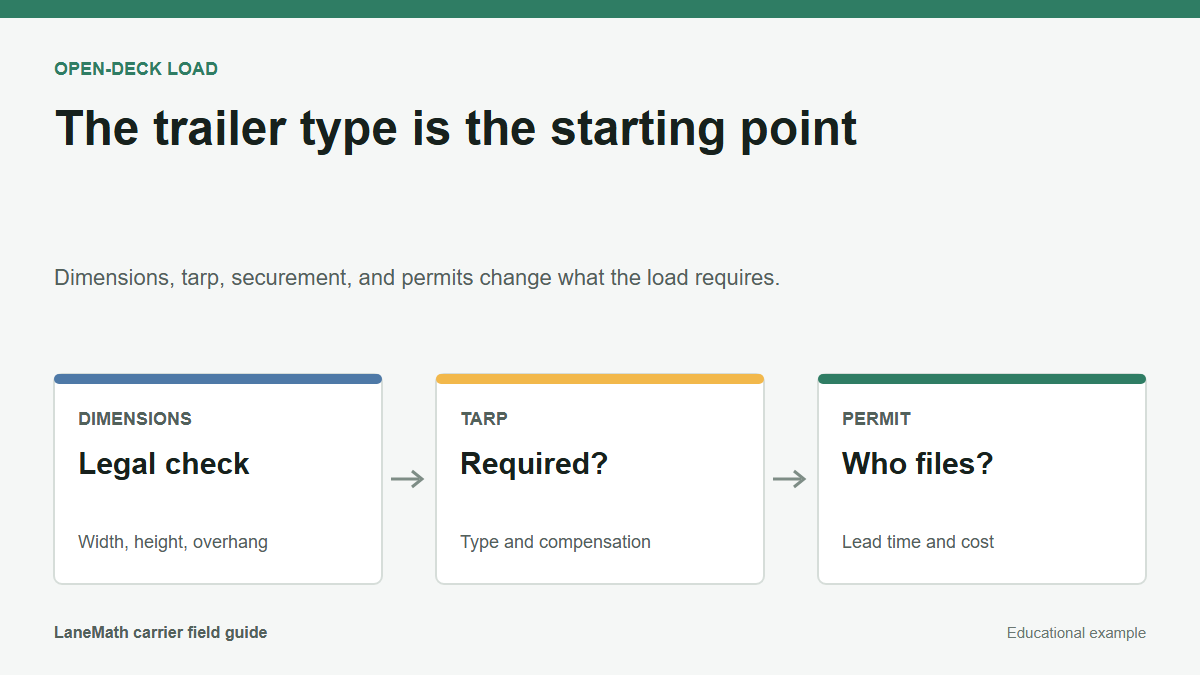
Open-deck load review table
Securement, dimensions, weather, and site access are the open-deck variables that differentiate loads with similar mileage and gross.
| Signal | Why it matters | Next check |
|---|---|---|
| Dimensions are listed | Legal width, height, and length limits vary by state. | Confirm whether a permit is required and who is responsible for it. |
| Tarp required is noted | Tarping adds physical labor and time before departure. | Ask what type of tarp is required and whether tarp pay is included. |
| Crane or rigging unloading | Site unloading equipment controls when the driver can release the load. | Ask about typical unload time and whether detention applies to crane delays. |
| Weather is a factor | Open-deck freight exposed to rain, wind, or cold may affect transit and delivery. | Confirm whether special instructions apply and who documents exceptions. |
Key takeaways
- Confirm tarps, chains, straps, dimensions, weight, permits, and loading method.
- Ask whether tarp pay or driver assist is included.
- Check weather, facility hours, and securement expectations.
Working frame for flatbed rate basics
A dispatch guide to open-deck details that can change time, labor, and risk, focused on equipment requirements, facility details, accessorial exposure, and usable written instructions. The first operating question is whether the subject changes money, time, equipment fit, payment exposure, or the truck's position after delivery. Keep those effects separate so one attractive number does not hide an unresolved condition.
Checks before the truck is committed
Confirm tarps, chains, straps, dimensions, weight, permits, and loading method. Ask whether tarp pay or driver assist is included. Check weather, facility hours, and securement expectations. Write down any term that still depends on a broker reply before dispatch. Confirm the exact commodity, weight, equipment, appointments, facility rules, and approval path that apply to this load rather than relying on a familiar lane or broker relationship.
Operating note
Flatbed value depends on securement work, loading method, dimensions, tarping, permits, weather, and site access. A short flatbed move can still be poor if tarping is heavy, cranes are late, or the receiver lacks unloading support. Before booking, ask what equipment is required and whether tarp pay, detention, driver assist, or permit responsibility is written clearly. The open-deck risk belongs in the rate conversation before the truck arrives.
How will the freight be loaded and secured?
Ask for dimensions, weight, commodity, loading method, securement expectations, tarp size, edge protection, permits, and delivery unloading method. Confirm whether the driver must climb, assist, or wait for a crane appointment. Photos or a clear load diagram can resolve uncertainty that a commodity name cannot.
Tarp pay does not describe the tarping job
A quoted tarp amount may not reflect height, number of pieces, weather exposure, or time on site. Another mistake is trusting legal weight without checking dimensions and axle distribution. The load can fit the gross weight and still require a different trailer, permits, or securement plan.
Keep the securement instructions
Save dimensions, weight, shipper instructions, approved equipment, permit information, tarp or driver-assist pay, and condition photos when appropriate. Note any shipper-requested change before departure. The records should support both service billing and the carrier's own cargo-handling review.
Example scenario
A steel load is described as legal and tarped. Photos reveal tall irregular pieces requiring more tarp work and edge protection than expected. The carrier asks for exact dimensions and revised tarp pay before committing equipment. The numbers and circumstances are educational examples; replace them with the actual route, written terms, costs, and operating limits for the load being considered.
What to check before booking
- Confirm tarps, chains, straps, dimensions, weight, permits, and loading method.
- Ask whether tarp pay or driver assist is included.
- Check weather, facility hours, and securement expectations.
- Write down any term that still depends on a broker reply before dispatch.
Common questions
What makes a flatbed load worth more or less than the mileage alone suggests?
Securement requirements, loading and unloading method, tarping, dimensions, permits, and site access can all change the effective value of a flatbed load. A load that requires heavy tarping, crane unloading, or an oversize permit changes the work and time commitment even when the city pair looks comparable to a simpler move.
Does flatbed freight require a different rate confirmation review than dry van?
Yes. Flatbed confirmations should be checked for securement responsibility, tarp pay, driver-assist requirements, oversize permit handling, load dimensions, and compliance items like escort vehicles. These details are more variable on open-deck loads and may not appear on a confirmation template designed for dry van.
When does a flatbed load require an oversize permit, and who is responsible for obtaining it?
Oversize permits are required when the load exceeds the legal width, height, or length limits for the states it travels through. Limits vary by state. The rate confirmation should specify who is responsible for obtaining and paying for required permits. If the broker is responsible, confirm the permits will be ready before the truck arrives for loading. If the carrier is responsible, factor permit cost and lead time into the pre-booking review.
How does weather affect flatbed planning differently than dry van?
Open-deck loads are directly exposed to rain, wind, and temperature. Some commodities — steel, building materials, lumber — may require re-tarping or additional inspection if weather is severe during transit. Unloading at a job site may be delayed by weather regardless of the carrier's arrival time. Flatbed carriers generally account for weather more explicitly in their planning than enclosed-trailer carriers.
References and methodology
- Operational Costs of Trucking - American Transportation Research Institute. Used here for: Per-mile carrier operational cost context for educational rate, fuel, and profitability examples.Annual industry report used for general cost-structure background. Not a source for lane-specific rates or broker pricing. Last checked 2026-06-29.
- Industry terminology and editorial explanation - LaneMath Editorial Desk. Used here for: Plain-English definitions, checklists, and example-only calculations.Editorial explanations are not official guidance, legal advice, or market data. Last checked 2026-06-29.