What documents to keep after delivery
A paperwork-first guide to organizing POD, BOL, rate confirmation, receipts, approvals, invoice notes, and revised confirmations after the load closes, including the written terms and records that matter before dispatch and after delivery.
Written and reviewed by LaneMath Editorial Team, with carrier workflow review from Dale Morrow where practical dispatch, paperwork, or lane-planning context is involved. Updated 2026-06-29. LaneMath pages use public references, example-only math, and conservative editorial review.
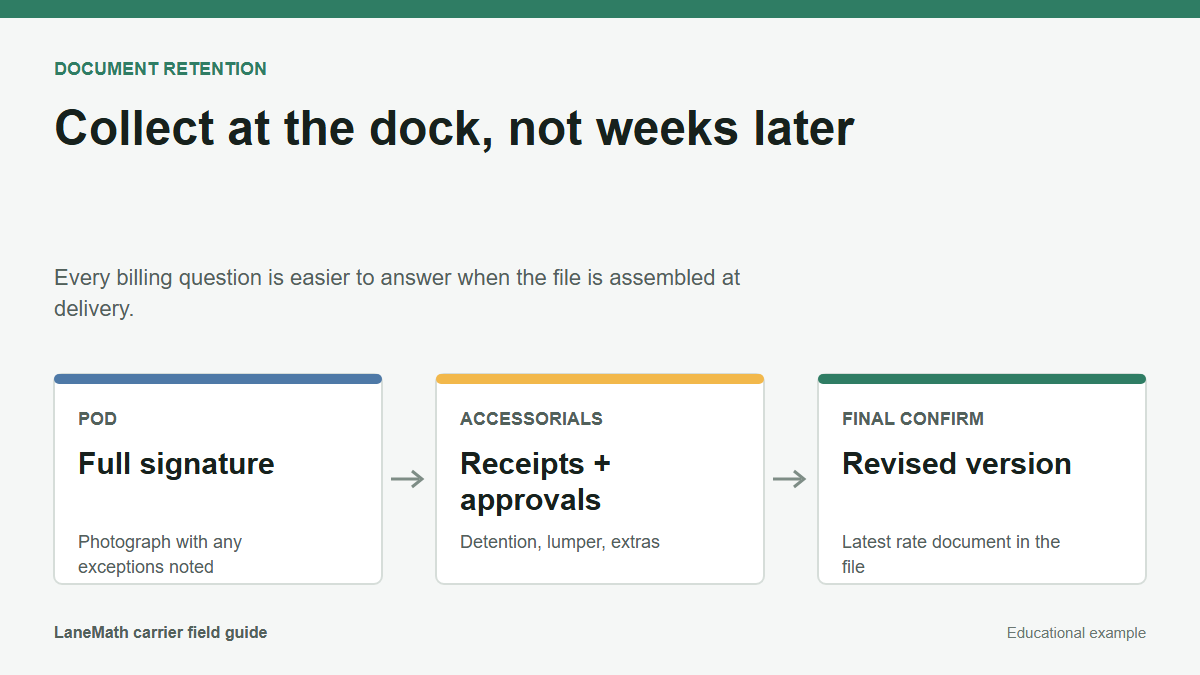
Post-delivery document checklist table
Documents are easiest to collect at the dock and hardest to reconstruct weeks later during billing.
| Signal | Why it matters | Next check |
|---|---|---|
| POD is signed but has a shortage note | An uncaptured exception can become a later dispute point without documentation. | Photograph the entire POD before leaving the receiver, including exception notations. |
| Load had accessorial events | Detention, lumper, or driver-assist costs need receipts and approvals in the same file. | Collect all accessorial records before departure and attach them to the invoice packet. |
| Rate changed after original signing | A billing packet with only the original confirmation may not support the billed amount. | Attach revised confirmations or written approvals to the invoice before submission. |
| Invoice is being submitted to a factoring company | Factor requirements may differ from broker requirements for which documents are needed. | Confirm the factor's document list and submit all required items together. |
Key takeaways
- Keep signed delivery paperwork before leaving the receiver.
- Save receipts and accessorial approvals with the load number.
- Review billing instructions before submitting the invoice.
Working frame for what documents to keep after delivery
A paperwork-first guide to organizing POD, BOL, rate confirmation, receipts, approvals, invoice notes, and revised confirmations after the load closes, including the written terms and records that matter before dispatch and after delivery. The first operating question is whether the subject changes money, time, equipment fit, payment exposure, or the truck's position after delivery. Keep those effects separate so one attractive number does not hide an unresolved condition.
Checks before the truck is committed
Keep signed delivery paperwork before leaving the receiver. Save receipts and accessorial approvals with the load number. Review billing instructions before submitting the invoice. Write down any term that still depends on a broker reply before dispatch. Confirm the exact commodity, weight, equipment, appointments, facility rules, and approval path that apply to this load rather than relying on a familiar lane or broker relationship.
Operating note
Post-delivery documentation is often treated as an afterthought, which is one reason short-pay disputes are common. The complete file includes the final signed confirmation, any revisions, accessorial approvals, BOL, POD, receipts, timestamps, and the invoice. The most commonly missing piece is the revised confirmation when original terms changed after booking. A carrier who keeps only the first version of the paperwork may have trouble supporting any charge that was not on that first document.
Build the packet while the load is fresh
The best time to organize documents is right after delivery, before small details disappear. Put the POD, BOL, confirmation, revised confirmations, receipts, approvals, invoice notes, and payment instructions together. If something is missing, write one dated note explaining what follow-up is needed.
Can billing close the load without another call?
Check for the final signed confirmation, revisions, BOL, readable POD, receipts, accessorial approvals, temperature or seal records when required, invoice instructions, and payment option. Ask whether the broker portal accepted each file before treating the packet as complete.
The missing document is often the revised one
Operations may retain the original confirmation but not the version that added a stop, lumper, or changed rate. Another common failure is leaving proof in a driver's phone until invoice time. The delivery packet should be assembled while the event and missing pieces are still easy to trace.
Close the file in a fixed order
Store agreement documents first, service proof second, receipts and approvals third, then invoice and submission confirmation. Mark any missing item and owner for follow-up. After payment, add settlement or remittance so the file shows both what was billed and what was received.
Example scenario
The driver sends a clear POD immediately, but the load also had an approved $180 stop added by email. Billing catches the missing revision during the post-delivery review and requests it before invoicing, avoiding a likely short pay. The numbers and circumstances are educational examples; replace them with the actual route, written terms, costs, and operating limits for the load being considered.
What to check before booking
- Keep signed delivery paperwork before leaving the receiver.
- Save receipts and accessorial approvals with the load number.
- Review billing instructions before submitting the invoice.
- Write down any term that still depends on a broker reply before dispatch.
Common questions
What is the most commonly missed document after delivery?
The revised rate confirmation. When a load involves accessorial approvals, appointment changes, or rate adjustments, the original confirmation may not match the final agreement. Carriers who file only the original confirmation can face billing disputes when the revised terms were never attached to the billing packet.
When is the right time to organize post-delivery documents?
Right after delivery, while the load is still fresh. Important details — dock timestamps, lumper receipts, temperature records, special instructions — are easiest to collect and verify before leaving the facility. Waiting until invoice time often means chasing documents that should have been captured on site.
How should a carrier organize load documents — by load number, date, or broker?
Load number is the most reliable primary key, as it appears on the rate confirmation, BOL, and invoice. Organizing by load number allows any document to be located from any other document in the same file. Date and broker name are useful secondary filters once the file is organized by load. Whatever system is used, consistency matters more than the specific format.
For how long should load documents be kept after a load is invoiced and paid?
There is no single LaneMath retention period for every document or carrier. Contracts, insurance policies, factoring terms, tax records, claims, and applicable regulations can impose different requirements. A carrier should adopt a written retention schedule based on those obligations and obtain professional guidance where a legal or tax period is unclear.
References and methodology
- Accessorial documentation editorial methodology - LaneMath Editorial Desk. Used here for: Detention, lumper, layover, TONU, revised confirmation, and post-delivery document workflow examples.Used for documentation workflows and example scenarios, not for legal claims about collectability. Last checked 2026-06-29.
- Rate confirmation educational reference - LaneMath Editorial Desk. Used here for: Educational discussion of rate confirmation review, revised confirmations, written approval, and document connections.Used for document literacy. It is not legal advice and does not replace professional review. Last checked 2026-06-29.