Lumper receipt documentation
A paperwork-first guide to checking lumper approval, receipt details, reimbursement handling, and billing documents before delivery paperwork is closed, including the written terms and records that matter before dispatch and after delivery.
Written and reviewed by LaneMath Editorial Team, with carrier workflow review from Dale Morrow where practical dispatch, paperwork, or lane-planning context is involved. Updated 2026-06-29. LaneMath pages use public references, example-only math, and conservative editorial review.
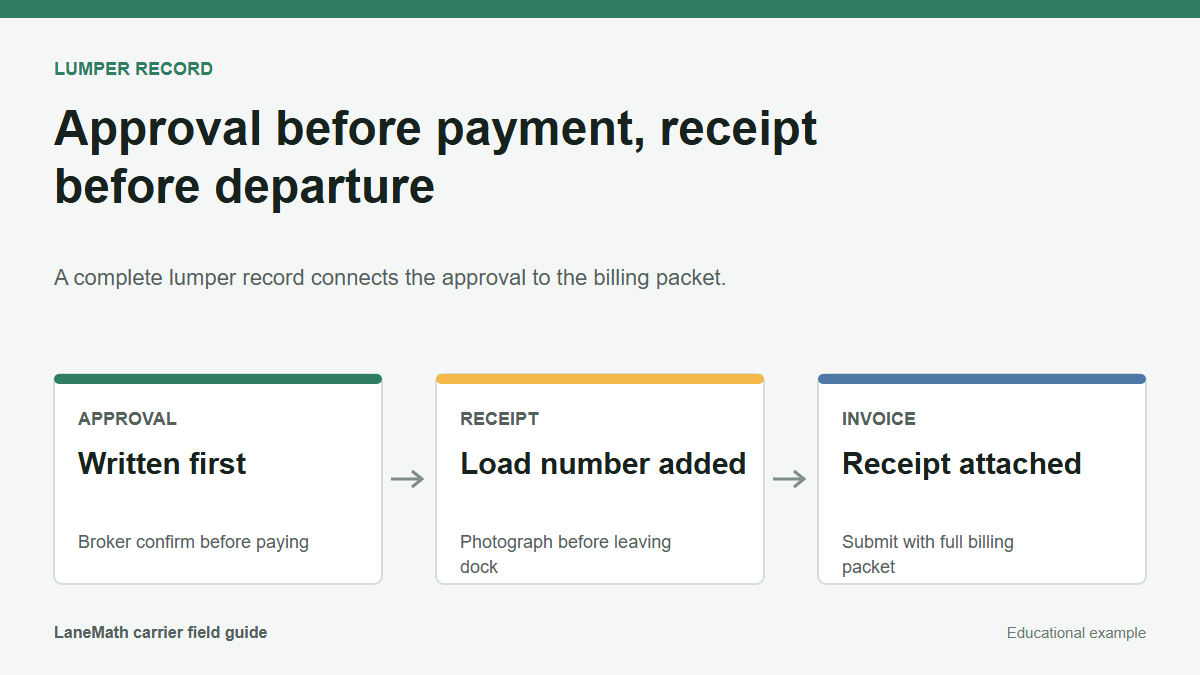
Lumper documentation table
A lumper receipt is most useful when it connects to load identification and a prior approval.
| Signal | Why it matters | Next check |
|---|---|---|
| Lumper service is required at the dock | The carrier needs written approval before paying to ensure reimbursement. | Contact the broker before paying and ask for a written approval or pay code. |
| Receipt lacks a load number | A receipt without load identification is difficult to match to a billing file. | Add the load number to the receipt manually and photograph it before leaving the dock. |
| Broker cannot be reached at the dock | A payment made without prior approval creates a weaker reimbursement claim. | Document the contact attempt, pay the lumper, and send a message immediately after. |
| Lumper cost exceeds the amount mentioned in the confirmation | An amount above the written cap may require an additional approval. | Photograph the receipt and contact the broker to confirm coverage before leaving. |
Key takeaways
- Ask whether the lumper must be approved before payment.
- Keep the receipt, payment method record, POD, and rate confirmation together.
- Confirm whether reimbursement appears on a revised confirmation or invoice note.
Working frame for lumper receipt documentation
A paperwork-first guide to checking lumper approval, receipt details, reimbursement handling, and billing documents before delivery paperwork is closed, including the written terms and records that matter before dispatch and after delivery. The first operating question is whether the subject changes money, time, equipment fit, payment exposure, or the truck's position after delivery. Keep those effects separate so one attractive number does not hide an unresolved condition.
Checks before the truck is committed
Ask whether the lumper must be approved before payment. Keep the receipt, payment method record, POD, and rate confirmation together. Confirm whether reimbursement appears on a revised confirmation or invoice note. Write down any term that still depends on a broker reply before dispatch. Confirm the exact commodity, weight, equipment, appointments, facility rules, and approval path that apply to this load rather than relying on a familiar lane or broker relationship.
Operating note
A lumper receipt is a billing record before it is an expense document. The carrier advances cash or card at the dock, but the receipt becomes part of the load billing file that the broker reimburses. If the receipt does not tie to a load reference, delivery address, and service date, it can be challenged at invoicing even when the service is legitimate. The receipt is strongest when it includes load reference, receiver name, date, dollar amount, and a brief description of the service performed. A photo backup before leaving the dock adds a second layer of protection.
The receipt is only one piece
A lumper receipt helps, but it is stronger with the approval path around it: receiver requirement, broker approval, payment code if used, receipt amount, BOL or POD connection, and invoice note. A receipt without context can still leave billing asking who approved the cost.
Will this receipt support reimbursement?
Before paying, ask whether broker approval is required and which payment method is allowed. Check that the receipt identifies the facility, date, amount, service, and load reference when available. If the receipt is vague, request supporting detail while still at the receiver.
A payment slip can be too thin for billing
A card receipt with only an amount may not connect the charge to the load. Carriers also send the receipt to dispatch but fail to attach it to the broker's required portal or invoice packet. Prior approval and usable proof solve different parts of reimbursement.
Keep the approval and receipt together
Save the broker request, written approval, lumper receipt, payment confirmation, facility and load reference, revised confirmation when issued, POD, and invoice line. Photograph paper receipts before leaving because heat and handling can make them unreadable.
Example scenario
A warehouse collects $310 through a kiosk that prints only a short transaction slip. The driver also captures the kiosk service screen and asks the clerk for a receipt tied to the delivery number, giving billing a clearer link between payment and load. The numbers and circumstances are educational examples; replace them with the actual route, written terms, costs, and operating limits for the load being considered.
What to check before booking
- Ask whether the lumper must be approved before payment.
- Keep the receipt, payment method record, POD, and rate confirmation together.
- Confirm whether reimbursement appears on a revised confirmation or invoice note.
- Write down any term that still depends on a broker reply before dispatch.
Common questions
What information should a lumper receipt include for reimbursement?
At minimum, the receipt should show the load number or reference, receiver name, date, dollar amount, and the service performed. A receipt missing load identification can be difficult to match to the billing file. If the receipt is handwritten, a photo backup before leaving the receiver is practical insurance.
What happens if a carrier pays for a lumper without prior broker approval?
The carrier may face resistance on reimbursement if the confirmation did not include lumper terms and the broker was not contacted before the charge was incurred. Brokers sometimes dispute lumper charges that were not pre-approved, even when the receiver required the service. Sending a quick message to the broker while at the dock creates a stronger approval record.
What is a lumper service and why does the carrier sometimes pay for it at the dock?
A lumper is an unloading service provided by workers at the receiver's facility. Some receivers require lumpers for all deliveries; others allow drivers to choose. Lumper fees are typically paid by the carrier at the dock using cash, check, a comcheck or EFS code, and then reimbursed by the broker. The rate confirmation should specify whether lumper is approved, how payment codes are provided, and what the maximum reimbursable amount is.
What should a carrier do if the receiver demands a lumper but the confirmation does not mention it?
Contact the broker before paying the lumper fee. Explain that the receiver requires lumper service, ask for a written approval or payment code, and confirm whether the amount will be added to the invoice. If the broker cannot be reached and the lumper must be paid to proceed, document the contact attempt, take a photo of the receipt, and send the broker a message immediately after paying that states the load number, facility, amount, and time.
References and methodology
- Accessorial documentation editorial methodology - LaneMath Editorial Desk. Used here for: Detention, lumper, layover, TONU, revised confirmation, and post-delivery document workflow examples.Used for documentation workflows and example scenarios, not for legal claims about collectability. Last checked 2026-06-29.