How to document a broker agreement
A practical risk review for keeping the load agreement clear from the first call through revised confirmations and billing paperwork, written for carriers that need cleaner broker checks and billing records before committing a truck.
Written and reviewed by LaneMath Editorial Team, with carrier workflow review from Dale Morrow where practical dispatch, paperwork, or lane-planning context is involved. Updated 2026-06-29. LaneMath pages use public references, example-only math, and conservative editorial review.
Agreement documentation table
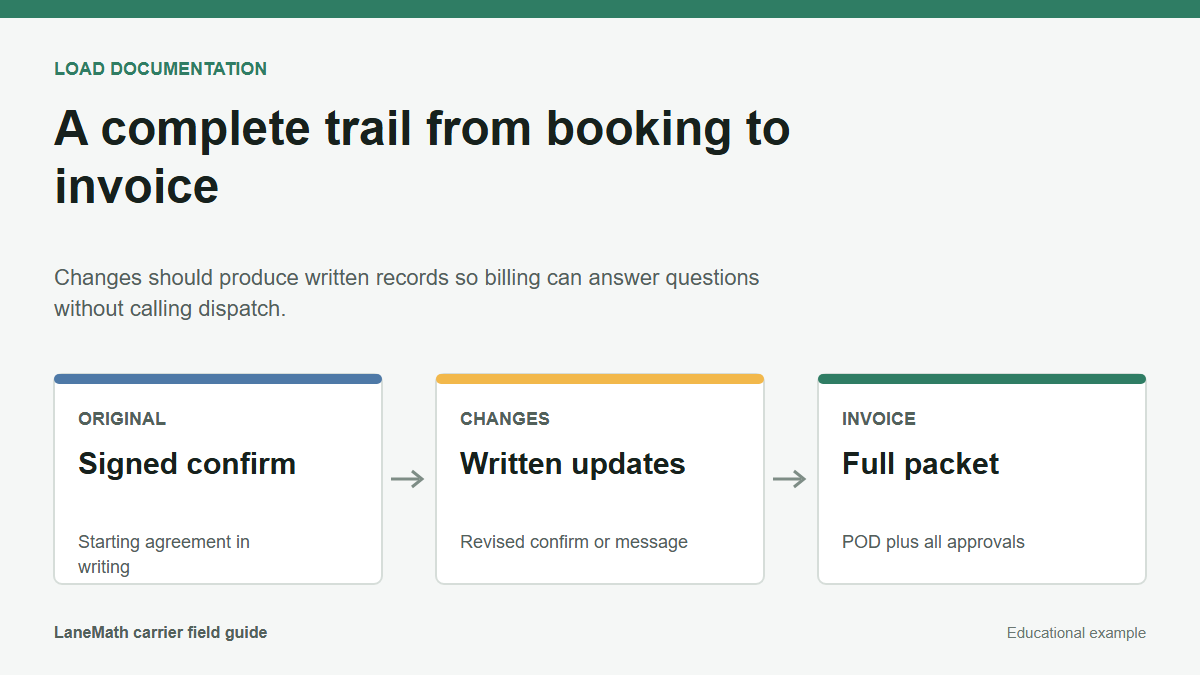
The load agreement is as strong as the trail of written records connecting each change to the original confirmation.
| Signal | Why it matters | Next check |
|---|---|---|
| Rate changed after the original call | A verbal rate revision is not in the billing file unless it is written. | Ask for a revised confirmation or send a message confirming the agreed amount. |
| Accessorial was approved by phone | Billing will ask for written evidence, not a recollection of the call. | Follow up in writing immediately after the phone approval. |
| Multiple revisions exist | The latest version controls, but billing must identify it correctly. | Label revised versions clearly and confirm dispatch uses the final document. |
| Load settled without all documents | A payment before the full file is assembled may close the billing window. | Organize documents at delivery, before invoicing rather than after payment. |
Key takeaways
- Save the signed confirmation and any revised versions.
- Record material call details in a short written follow-up.
- Keep approvals, receipts, BOL, POD, and invoice notes together.
Working frame for how to document a broker agreement
A practical risk review for keeping the load agreement clear from the first call through revised confirmations and billing paperwork, written for carriers that need cleaner broker checks and billing records before committing a truck. The first operating question is whether the subject changes money, time, equipment fit, payment exposure, or the truck's position after delivery. Keep those effects separate so one attractive number does not hide an unresolved condition.
Checks before the truck is committed
Save the signed confirmation and any revised versions. Record material call details in a short written follow-up. Keep approvals, receipts, BOL, POD, and invoice notes together. Write down any term that still depends on a broker reply before dispatch. Confirm the exact commodity, weight, equipment, appointments, facility rules, and approval path that apply to this load rather than relying on a familiar lane or broker relationship.
Operating note
A broker agreement is only as strong as its document trail. A verbal call establishes what each side expected; the rate confirmation, email approval, and revised confirmation establish what each side agreed to in writing. When the two versions differ, the written document usually controls. The practical habit is simple: if the load, rate, or terms changed after the original conversation, something in writing should reflect the change before the truck departs.
Agreement history matters
A broker agreement is rarely one document after the load changes. It can be the first confirmation, a revised confirmation, an email approving a lumper, a message changing appointment time, and the final delivery paperwork. Keep the history in order so the final billing packet shows how the agreement evolved.
Which version contains the final deal?
Identify the original posting, call terms, first confirmation, later revisions, accessorial approvals, appointment changes, and billing instructions. Ask the broker to correct conflicts rather than stacking another vague message on top. The goal is a readable agreement history, not the largest possible message folder.
The latest message can lose earlier context
A revised rate may omit an accessorial term from the first confirmation, or an appointment email may change timing without mentioning rate. Treating the newest document as complete without comparing versions can erase a term unintentionally. Screenshots without sender, date, or load number create a similar problem.
File the agreement in order
Store the signed confirmation, revisions, approvals, instructions, BOL, POD, receipts, and invoice chronologically under one load number. Label superseded documents. A short index note listing the final rate, appointments, and approved extras can help billing navigate a load with several changes.
Example scenario
A load begins at $2,400, gains a $150 stop, and later receives a delivery-time revision. The carrier keeps all three documents and a final note showing $2,550 plus the new appointment, preventing billing from using the first confirmation by mistake. The numbers and circumstances are educational examples; replace them with the actual route, written terms, costs, and operating limits for the load being considered.
What to check before booking
- Save the signed confirmation and any revised versions.
- Record material call details in a short written follow-up.
- Keep approvals, receipts, BOL, POD, and invoice notes together.
- Write down any term that still depends on a broker reply before dispatch.
Common questions
What documents make up a complete broker agreement for billing?
A complete file typically includes the signed rate confirmation, any revised confirmations, written accessorial approvals, BOL, POD, receipts for out-of-pocket charges, and the invoice. If the agreement changed from the first call, the revision history should be traceable through documents rather than a remembered conversation.
How long should carriers keep load documentation after payment?
Keeping load files through at least one full settlement cycle after the invoice is paid allows the carrier to resolve any short-pay or deduction questions that arise during processing. The minimum useful period is tied to the broker's payment dispute window and the carrier's billing cycle.
What is the most common gap in carrier load documentation that causes billing disputes?
Missing revised confirmations. When a load changes after the original confirmation — rate adjustment, appointment change, accessorial addition — the revision is often handled verbally or by email but never attached to the billing file. The invoice then references a load that the original confirmation does not fully describe, and billing disputes arise from the gap.
Does a carrier need a separate document for each change to the original agreement?
Not necessarily a separate physical document each time, but each change should be traceable — through a revised confirmation, a written email exchange, or a dated message referencing the load number and the change. A file that shows the original confirmation plus two email exchanges reflecting two later changes is a more complete record than a single document that nobody updated.
References and methodology
- Broker negotiation editorial methodology - LaneMath Editorial Desk. Used here for: Broker call preparation, rate discussion, appointment changes, written confirmations, and walk-away decision examples.Used for practical negotiation education. It does not provide legal advice, pricing promises, or broker recommendations. Last checked 2026-06-29.
- Rate confirmation educational reference - LaneMath Editorial Desk. Used here for: Educational discussion of rate confirmation review, revised confirmations, written approval, and document connections.Used for document literacy. It is not legal advice and does not replace professional review. Last checked 2026-06-29.