How to check pickup and delivery windows
A load-selection guide to reviewing appointment windows, facility hours, check-in rules, dwell risk, and delivery recovery time, built around what to ask, what to verify, and what to write down before the truck moves.
Written and reviewed by LaneMath Editorial Team, with carrier workflow review from Dale Morrow where practical dispatch, paperwork, or lane-planning context is involved. Updated 2026-06-29. LaneMath pages use public references, example-only math, and conservative editorial review.
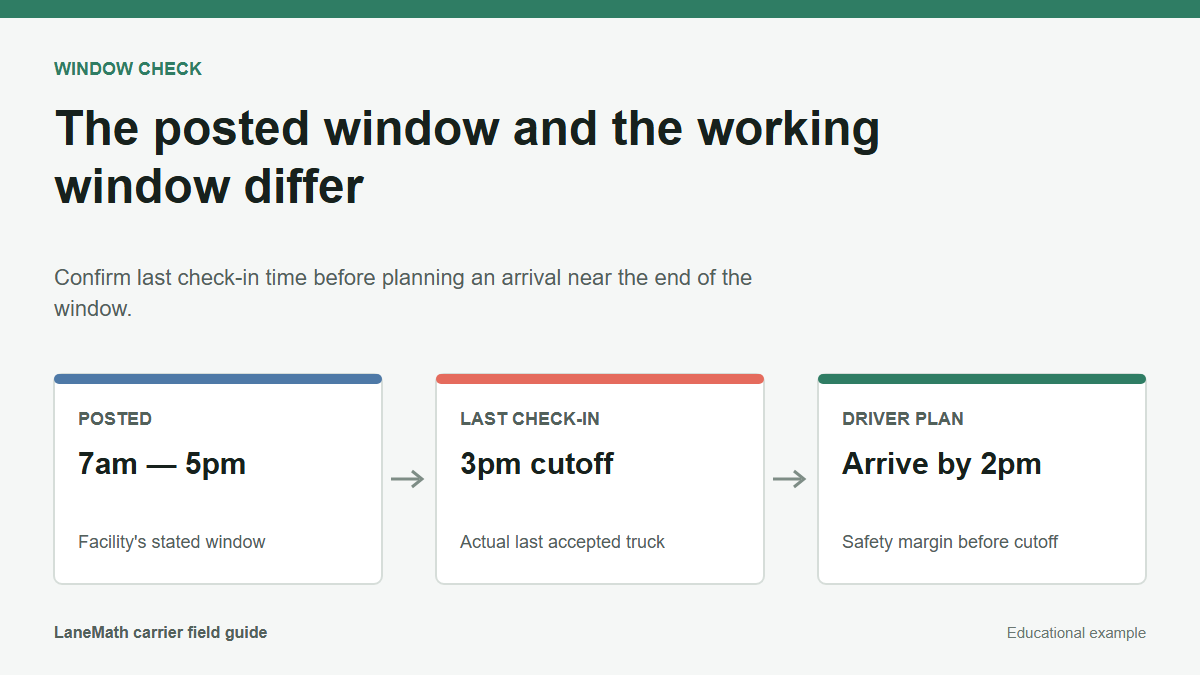
Window verification table
Posted appointment information should be verified against facility reality before the driver plans a departure.
| Signal | Why it matters | Next check |
|---|---|---|
| Window is shown but type is unclear | A listed window may be firm, FCFS, or customer-specified with different cutoffs. | Ask whether the window is a hard appointment or a first-come arrival range. |
| Driver must arrive at end of window | Last-check-in time may close before the posted window ends. | Confirm the last time the facility accepts incoming trucks. |
| Appointment is at an early morning time | Hours of service from the prior day may prevent the driver from arriving legally. | Verify the driver's restart and available hours before the appointment is accepted. |
| Appointment was given verbally only | A verbal appointment that differs from the confirmation has no document anchor. | Ask for the written appointment in the confirmation before dispatch. |
Key takeaways
- Ask whether the appointment is firm, FCFS, or a window.
- Confirm check-in requirements and late-arrival handling.
- Compare the window against hours of service, parking, and reload timing.
Working frame for how to check pickup and delivery windows
A load-selection guide to reviewing appointment windows, facility hours, check-in rules, dwell risk, and delivery recovery time, built around what to ask, what to verify, and what to write down before the truck moves. The first operating question is whether the subject changes money, time, equipment fit, payment exposure, or the truck's position after delivery. Keep those effects separate so one attractive number does not hide an unresolved condition.
Checks before the truck is committed
Ask whether the appointment is firm, FCFS, or a window. Confirm check-in requirements and late-arrival handling. Compare the window against hours of service, parking, and reload timing. Write down any term that still depends on a broker reply before dispatch. Confirm the exact commodity, weight, equipment, appointments, facility rules, and approval path that apply to this load rather than relying on a familiar lane or broker relationship.
Operating note
Pickup and delivery windows are a scheduling promise with operational consequences. A window allowing arrival between 7 a.m. and 5 p.m. is different from a firm appointment at 10 a.m., even if both appear as 'scheduled' on the posting. The practical questions are whether late arrival creates a penalty or rescheduling delay, whether early arrival is accepted, and whether the confirmation's language reflects the actual window offered. Carriers should verify the written window matches the broker's verbal description before finalizing dispatch timing.
Is the time a window, appointment, or facility limit?
Confirm earliest arrival, latest check-in, whether arrival outside the range is accepted, rescheduling process, and who controls the appointment. Ask about time zones and overnight parking. A broad window may still hide a cutoff that changes how the driver plans the day.
FCFS does not mean any time
First-come, first-served facilities still have operating hours, queues, and last check-in rules. Dispatchers also confuse a broker-requested arrival with a receiver-confirmed appointment. If the two differ, the carrier needs to know which time the facility will honor.
Write times with source and time zone
Keep the confirmation, scheduling email or number, facility hours, appointment type, time zone, and any reschedule notice. Record actual arrival and release when timing affects detention or service. A bare time in a text message is easy to misread across regions.
Example scenario
A receiver is listed as FCFS from 7 a.m. to 3 p.m., but last check-in is 1:30 p.m. The truck's route supports a 2 p.m. arrival, which is inside the posted range but too late for service. The cutoff changes the load from workable to risky. The numbers and circumstances are educational examples; replace them with the actual route, written terms, costs, and operating limits for the load being considered.
What to check before booking
- Ask whether the appointment is firm, FCFS, or a window.
- Confirm check-in requirements and late-arrival handling.
- Compare the window against hours of service, parking, and reload timing.
- Write down any term that still depends on a broker reply before dispatch.
Common questions
What is the difference between a firm appointment and a delivery window?
A firm appointment is a specific time the carrier is expected to arrive. A delivery window is a range within which the carrier may deliver. Firm appointments carry more consequence for late arrivals; windows offer more flexibility but may still have cutoff times. The distinction matters for hours-of-service planning, detention eligibility, and reload timing.
Should a carrier verify appointment windows on the rate confirmation, not just from the phone call?
Yes. Appointment times on the rate confirmation are the ones that govern billing and service disputes. A phone-call appointment that differs from the written document creates ambiguity. If the broker provides a different time verbally, asking for a revised confirmation before dispatching creates a cleaner record.
What is a reasonable buffer to plan around a firm delivery appointment?
A buffer depends on the trip distance, drive time variability, and the consequences of late arrival at that specific receiver. A two-hour buffer on a local 150-mile run is different from planning for a 700-mile run with a morning appointment. The key questions are what the facility does when a truck arrives late — rescheduling versus TONU versus reduced unloading priority — and how that outcome changes the load economics.
Can a carrier count on the broker to notify them if an appointment changes?
Brokers typically pass along appointment changes, but the carrier cannot always count on advance notice when changes originate at the shipper or receiver. Carriers running tight appointments often contact the facility directly the evening before delivery to confirm the appointment is still active. That extra step surfaces problems with enough lead time to adjust.
References and methodology
- Load comparison example methodology - LaneMath Editorial Desk. Used here for: Example-only load comparison, weekly freight planning, reload uncertainty, and equipment-specific economics.Used for static planning examples based on carrier-entered assumptions, not pricing feeds or market forecasts. Last checked 2026-06-29.
- Accessorial documentation editorial methodology - LaneMath Editorial Desk. Used here for: Detention, lumper, layover, TONU, revised confirmation, and post-delivery document workflow examples.Used for documentation workflows and example scenarios, not for legal claims about collectability. Last checked 2026-06-29.