How small carriers can compare broker offers
A practical risk review for comparing multiple broker offers by total miles, timing, accessorial language, payment terms, and reload uncertainty, written for carriers that need cleaner broker checks and billing records before committing a truck.
Written and reviewed by LaneMath Editorial Team, with carrier workflow review from Dale Morrow where practical dispatch, paperwork, or lane-planning context is involved. Updated 2026-06-29. LaneMath pages use public references, example-only math, and conservative editorial review.
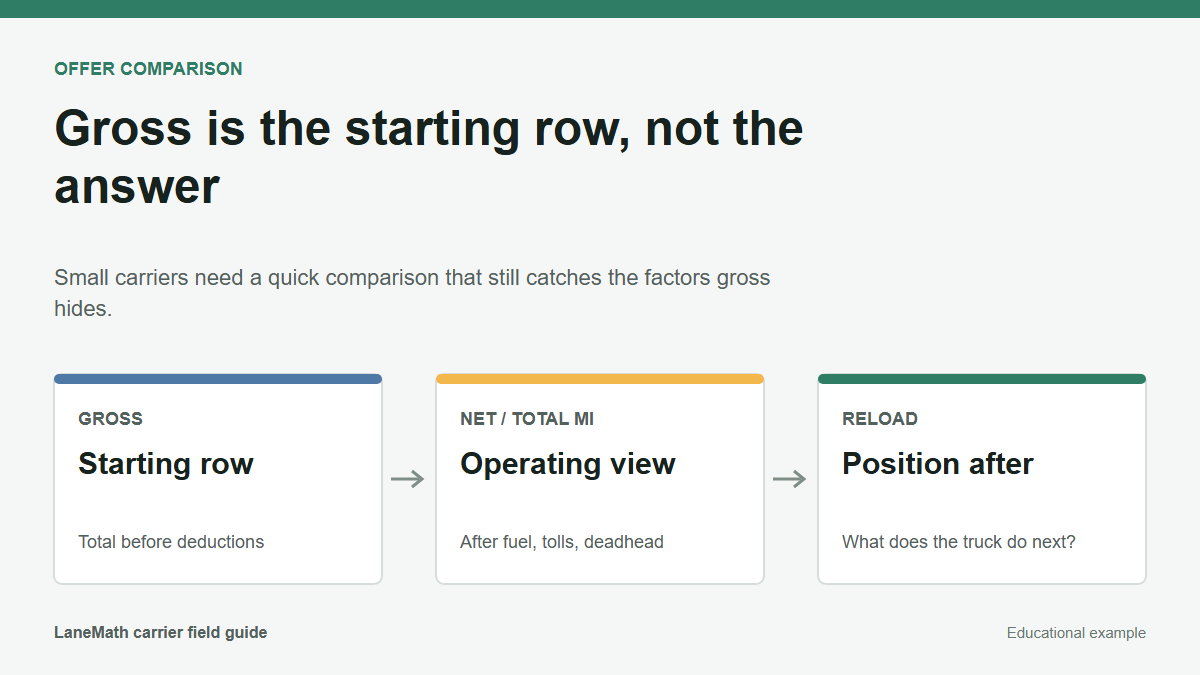
Multi-offer comparison table
Small carriers with limited trucks need a comparison that produces a clear answer quickly without sacrificing accuracy.
| Signal | Why it matters | Next check |
|---|---|---|
| Two offers look similar on gross | Gross rarely captures the full picture for a small operation. | Add total miles, dwell risk, reload position, and payment terms to the comparison. |
| One broker has a short payment history | Factoring eligibility or a quick-pay option may not be available. | Check whether cash flow timing changes which offer is actually better. |
| One load has better reload position | Post-delivery positioning affects the next load, which affects the week. | Estimate what a good next load from each delivery market might look like. |
| Both loads expire soon | Time pressure can cause a decision based on which call came most recently. | Commit to a quick written comparison using the same rows for both offers. |
Key takeaways
- Put each offer into the same total-mile and time format.
- Compare payment terms and paperwork requirements before choosing.
- Do not let a higher gross number hide unpaid miles or weak documents.
Working frame for how small carriers can compare broker offers
A practical risk review for comparing multiple broker offers by total miles, timing, accessorial language, payment terms, and reload uncertainty, written for carriers that need cleaner broker checks and billing records before committing a truck. The first operating question is whether the subject changes money, time, equipment fit, payment exposure, or the truck's position after delivery. Keep those effects separate so one attractive number does not hide an unresolved condition.
Checks before the truck is committed
Put each offer into the same total-mile and time format. Compare payment terms and paperwork requirements before choosing. Do not let a higher gross number hide unpaid miles or weak documents. Write down any term that still depends on a broker reply before dispatch. Confirm the exact commodity, weight, equipment, appointments, facility rules, and approval path that apply to this load rather than relying on a familiar lane or broker relationship.
Use the tie-breaker column
When two offers are close, add a tie-breaker column. Write one sentence for each load: what could make this load worse than it looks? The answer might be a weak reload, slow receiver, unclear lumper approval, late appointment, or broker payment concern. That sentence often makes the better choice obvious.
Are the offers being compared on the same basis?
Normalize gross revenue, loaded and empty miles, trip days, appointment risk, direct costs, payment timing, accessorial language, and reload position. Ask what remains uncertain in each offer. The comparison should use the same mileage source and cost assumptions or clearly explain why they differ.
Highest gross often wins before the rows are filled in
A larger offer can require more unpaid miles, a slower receiver, or a broker the carrier cannot factor. Small carriers also compare rate per mile while ignoring calendar time, causing a two-day load and a three-day load to look closer than they are.
Keep the losing offer long enough to learn
Save a short comparison with both offers, assumptions, and the reason one was selected. After delivery, add actual miles, time, and major cost differences. The purpose is not to archive every posting; it is to improve how close decisions are made.
Example scenario
Offer A pays $2,800 over two planned days with 60 empty miles. Offer B pays $3,150 but needs three days, 145 empty miles, and a slow-paying broker. Converting both to total miles and calendar time may reverse the first impression created by gross revenue. The numbers and circumstances are educational examples; replace them with the actual route, written terms, costs, and operating limits for the load being considered.
What to check before booking
- Put each offer into the same total-mile and time format.
- Compare payment terms and paperwork requirements before choosing.
- Do not let a higher gross number hide unpaid miles or weak documents.
- Write down any term that still depends on a broker reply before dispatch.
Common questions
What should small carriers compare besides gross revenue?
Compare total miles, appointment timing, reload position, broker payment terms, accessorial language, paperwork requirements, facility risk, and out-of-pocket costs.
Can two offers with similar miles have different value?
Yes. Timing, receiver dwell, payment risk, reload options, and written accessorial terms can make two similar-mile loads very different operationally.
How many offers should a small carrier compare before committing?
There is no fixed number. Comparing two solid offers is usually sufficient for a clear decision. Spending an hour chasing a third or fourth offer while the first two expire is often a worse outcome than choosing promptly between two good options. The goal is a timely, informed decision, not an exhaustive market survey.
What does a small carrier do when both offers look about equal?
Use the tie-breaker factors: which broker has the cleaner payment history, which load has less dwell risk at the receiver, and which destination sets up better freight after delivery. If those are still equal, the load with the simpler accessorial situation and cleaner written terms is generally lower-risk for a small operation.
References and methodology
- Broker negotiation editorial methodology - LaneMath Editorial Desk. Used here for: Broker call preparation, rate discussion, appointment changes, written confirmations, and walk-away decision examples.Used for practical negotiation education. It does not provide legal advice, pricing promises, or broker recommendations. Last checked 2026-06-29.
- Load comparison example methodology - LaneMath Editorial Desk. Used here for: Example-only load comparison, weekly freight planning, reload uncertainty, and equipment-specific economics.Used for static planning examples based on carrier-entered assumptions, not pricing feeds or market forecasts. Last checked 2026-06-29.